Last Updated: November 4, 2026
Quick Summary
For safe roof cleaning, keep DIY work to simple tasks you can do from the ground, and leave steep, slick, damaged, or hard-to-reach areas to a qualified professional. Do not walk on shingles, scrape moss, use a pressure washer on asphalt shingles, or attempt chemical treatment without professional assessment.
- Wear gloves and eye protection when handling debris.
- Set ladders on firm, level ground and keep clear of overhead wires.
- Check the forecast; work only in dry, calm conditions.
- Ask a qualified roofer to assess widespread growth or brittle, damaged shingles.
Table of Contents
- DIY Roof Cleaning Safety: What Should Homeowners Know?
- Roof Cleaning Safety Equipment: What to Prepare Before You Start
- Step 1: Check Roof Conditions and Choose a Safe Scope
- Step 2: How to Remove Moss from Roof Without Damaging Shingles
- Step 3: Choose the Best Time of Year to Remove Moss from Roof
- Step 4: How to Prevent Algae on Roof Without Risky Cleaning
- When to Book a Professional Soft Wash Roof Cleaning
- Frequently Asked Questions
DIY Roof Cleaning Safety: What Should Homeowners Know?
Roof cleaning safety starts with one choice: stay off the roof if the work needs climbing, strong chemicals, or high-pressure washing. This guide from Freedom Wash Club explains practical DIY roof cleaning safety tips for homeowners, including what to check, what to avoid, and when to call a professional. Roof cleaning is the care of roof surfaces to remove growth and debris without harming the roof. The safest plan protects both the shingles and the person doing the work.
According to the Asphalt Roofing Manufacturers Association guidance on asphalt roof maintenance, soft washing is the recommended method for cleaning asphalt roofs. High-pressure washing can strip shingle granules and contribute to leaks, according to Family Window Washing’s roof-cleaning safety guidance. The common mistake is treating roof cleaning as a simple wash. It is a safety decision first.
Roof Cleaning Safety Equipment: What to Prepare Before You Start
Roof cleaning safety equipment helps only when the task itself is safe to do from the ground. For basic ground-level work, prepare gloves, eye protection, a stable ladder, and a roof rake. Never climb onto a wet or steep roof to reach a patch of moss.
Before starting, check that you have:
- A stable ladder on firm, level ground
- Gloves and eye protection for debris
- A roof rake for reachable loose material
- A garden hose for nearby plant care
- A clear path away from overhead wires
Ladders should extend at least three feet above the roof edge, according to Ma Thompson Roofing’s ladder safety guidance. That does not make roof access safe by itself. If you cannot set the ladder securely or keep both feet on it, stop and call a professional.
Step 1: Check Roof Conditions and Choose a Safe Scope
The safest DIY roof cleaning plan stays on the ground and limits work to simple maintenance. Look for roof pitch, loose or damaged shingles, moss, lichen, and organic debris from a safe spot. Do not walk on shingles to inspect them.
A common mistake is deciding to climb before checking the roof. Falls and chemical exposure are known risks of DIY roof cleaning, as noted in the r/SoutheastSoftwash community safety discussion. Clearing reachable debris and maintaining gutters are generally safer homeowner tasks, according to Roof Maxx.
Use this quick scope check:
- Clear debris only if you can reach it safely.
- Leave steep, slick, or damaged areas alone.
- Avoid work near power lines.
- Get a professional assessment for chemical treatment.
For steep or hard-to-reach roofs, read our guide to safe cleaning for steep roofs before choosing a scope.
Use this scope check to keep DIY work safe and limited.
| Task or condition | What to do |
|---|---|
| Reachable debris | Clear only if you can reach it safely |
| Steep, slick, or damaged areas | Leave them alone |
| Work near power lines | Avoid it |
| Chemical treatment | Get a professional assessment |
Step 2: How to Remove Moss from Roof Without Damaging Shingles
Moss, algae, and lichen are not interchangeable: moss forms soft, raised clumps that hold moisture; algae often appears as dark streaks; and lichen forms a firmly attached, crusty growth. Identifying the growth helps set expectations, but it does not make climbing or forceful removal safe. On asphalt shingles, pulling moss or scraping lichen can dislodge protective granules, while high-pressure washing can drive water beneath shingles and accelerate wear.
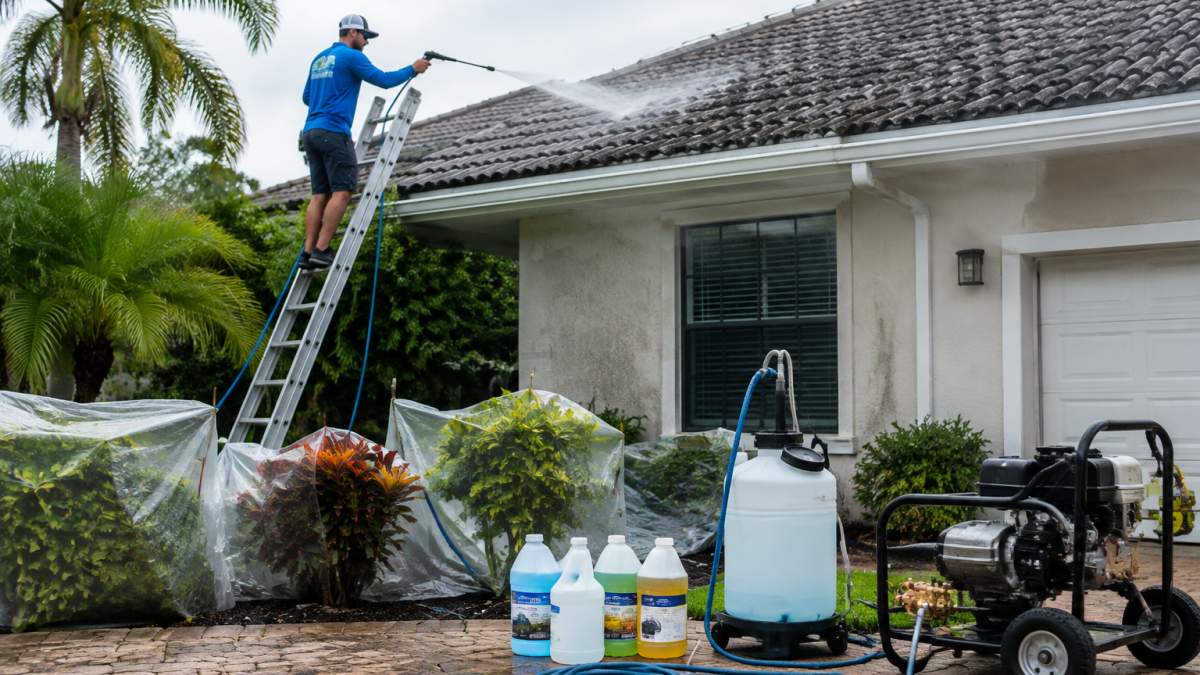
A soft wash uses low-pressure application rather than a forceful jet; it is not a guarantee that every chemical or technique is safe for every roof. Wood shakes, slate, tile, and metal have different surface and installation requirements, so do not assume a method suitable for asphalt is suitable for another material. Check the roofing manufacturer’s care instructions and warranty terms before any treatment, and ask a qualified roofer if the material or roof condition is uncertain.
- Do not walk on the roof, scrape growth, or pull moss from shingles.
- Do not use a pressure washer on asphalt shingles.
- Do not mix cleaning products or improvise a chemical recipe; combinations can create hazardous fumes or damage surfaces.
- Before any professional treatment, ask what product and application method will be used, how nearby plants and drainage will be protected, and whether the method complies with the roof manufacturer’s instructions.
- Keep cleaning solution and rinse water out of storm drains and away from gardens, ponds, and other sensitive areas; follow product-label directions for handling and disposal.
Watch out: A product described as “roof safe” is not automatically safe for every roofing material, landscaping, or warranty; verify the label and manufacturer guidance before use.
Preserve the warranty paperwork and document the roof’s condition before arranging cleaning. If growth is widespread, shingles are brittle or damaged, or treatment would require roof access, have a qualified professional assess the roof rather than attempting removal yourself. For more guidance on shingle care, see beginner tips for roof shingles.
Step 3: Choose the Best Time of Year to Remove Moss from Roof
The best time of year to remove moss from a roof is when conditions are dry and calm, with no rain or strong wind expected during the work. A dry surface is easier to assess, and calm weather reduces the chance of slips or poor ladder control. Do not treat a calendar date as a safety guarantee.
Check the forecast and the roof before doing even ground-level work. Overhanging branches can add shade and organic debris, while moisture retention can encourage moss growth. Roof ventilation and gutter maintenance also help limit damp conditions.
A simple seasonal check can keep the task in scope:
- Look for debris after storms.
- Check gutters when they are easy to reach.
- Trim branches only from a safe position.
- Leave roof work to trained professionals.
Step 4: How to Prevent Algae on Roof Without Risky Cleaning
Prevention is safer than repeatedly scraping or washing a roof, but it works best when it addresses the conditions that support growth. Algae commonly leaves dark streaks, while moss and lichen have different forms and may need a separate assessment. Shade, trapped debris, and slow drainage can keep roof surfaces damp longer; reducing those conditions can help limit recurring growth without putting a homeowner on the roof.
Copper and zinc strips work through rainwater runoff: as water passes over the metal, small amounts of metal ions wash down the roof and inhibit growth on the areas reached by that runoff. Coverage is not necessarily uniform, and the effect can be weaker below roof features that interrupt water flow. Strips are a preventive measure, not a way to remove established moss or repair damaged shingles. Because installation involves roof access and can affect roofing details, ask a qualified roofer whether strips suit the roof material and installation.
- Keep gutters and downspouts clear so water can drain rather than back up at the roof edge.
- From the ground, remove reachable leaves and branches that collect on the roof; do not climb to clear debris.
- Consider trimming overhanging branches when the work can be done safely, while preserving appropriate tree health and avoiding overhead wires.
- Ask a roofer to check for drainage problems, damaged shingles, or other conditions that may keep an area wet.
- Avoid repeated chemical treatments without identifying the growth and checking the roof manufacturer’s care instructions.
Watch out: Do not install metal strips or trim branches from a ladder or roof if the task requires leaning, reaching over the roof edge, or working near power lines.
Use visual checks from the ground and after storms, and arrange a professional assessment if growth returns quickly or covers a broad area. For more on reducing recurring growth, read ways to prevent roof mold.
When to Book a Professional Soft Wash Roof Cleaning
Book a professional soft wash roof cleaning when the roof is steep, growth covers a large area, shingles look damaged, or chemical treatment is needed. The right method still depends on roof material and condition.
Freedom Wash Club provides roof cleaning, house wash and exterior home cleaning, driveway cleaning, pool deck cleaning, and paver sealing. We are licensed and insured, and homeowners can schedule by phone or text without an in-person estimate. You can compare soft washing and high-pressure cleaning, then read how to find a reliable roof cleaner before hiring.
DIY roof cleaning safety tips for homeowners come down to a firm boundary: handle simple ground-level upkeep, but do not risk a fall to remove roof growth. For roof cleaning, driveway cleaning, pool deck cleaning, house washing, or paver sealing, get started with Freedom Wash Club and request a free quote.
Frequently Asked Questions
What kills moss and algae on roofs?
Chemical handling and runoff also require care. Follow the product label and roof manufacturer’s guidance, and leave treatment to a professional if safe access or correct application is uncertain.
What time of year should you remove moss from your roof?
There is no single best time of year for every roof. Choose a dry, calm day when the roof and access area are not slippery, and avoid working in conditions that make ladder use or chemical application unsafe. Moss removal should not require walking on shingles. If growth is extensive or the roof is steep, arrange a professional assessment rather than waiting for a particular season.
How do you remove moss from roof shingles without damaging them?
Do not mix or apply chemicals unless you understand the label directions and runoff precautions. For substantial moss, steep pitches, or uncertain shingle condition, hire a professional cleaner.
Can you clean a roof without walking on it?
Avoid stepping onto shingles, especially when they are wet or steeply pitched. If the cleaning area cannot be reached safely, stop rather than improvising with a ladder or pressure washer.