Last Updated: November 4, 2026
Quick Summary
For driveway mold, match the cleaner to the problem: Mold Armor Concrete Cleaner for root-level removal, Wet & Forget for spray-and-forget convenience, and RMR-86 Pro for stubborn, deep-set stains. Simple Green Oxy Solve suits eco-friendly routine cleaning, while Concrobium Mold Control prevents regrowth after cleaning.
- Mold Armor Concrete Cleaner starts at $12.98 and uses Microban foaming action for root-level removal.
- Wet & Forget works over time through natural weathering and needs no scrubbing, but requires patience.
- Wear gloves, eye protection, and a respirator when applying RMR-86 Pro, and keep pets and kids clear.
- Simple Green Oxy Solve is peroxide-based and biodegradable, and runs through a pressure washer detergent tank.
- Apply cleaners in early morning or late afternoon, since surface temperatures above roughly 85°F shorten dwell time.
Table of Contents
- Quick Comparison: Top Driveway Mold Cleaners
- 1. Mold Armor Concrete Driveway Sidewalk Cleaner: Best for Root-Level Removal
- 2. Wet & Forget Moss, Mold, Mildew & Algae Stain Remover: Best Spray-and-Forget Option
- 3. RMR-86 Pro Instant Mold and Mildew Stain Remover: Best for Stubborn Stains
- 4. Simple Green Oxy Solve Concrete and Driveway Cleaner: Best Eco-Friendly Formula
- 5. Concrobium Mold Control: Best for Preventing Regrowth
- How to Apply Driveway Mold Cleaners: Step-by-Step
- When to Call a Professional Driveway Cleaning Service Near Me
- Frequently Asked Questions
Quick Comparison: Top Driveway Mold Cleaners
Driveway mold is more than an eyesore. Those black streaks and green patches are living organisms feeding on dirt, pollen, and moisture trapped in the concrete, and left alone they spread deeper into the surface. This guide from Freedom Wash Club breaks down the best driveway cleaning solutions for mold and mildew, from fast-acting sprays to eco-friendly formulas.
Here’s the short version before we get into the details:
| Cleaner | Best For | Starting Price | Key Strength |
|---|---|---|---|
| Mold Armor Concrete Cleaner | Root-level removal | $12.98 | Microban foaming action |
| Wet & Forget | Spray-and-forget | $39.00 | No scrubbing needed |
| RMR-86 Pro | Stubborn stains | $25.00 | Industrial-strength speed |
| Simple Green Oxy Solve | Eco-friendly use | $18.00 | Peroxide-based, biodegradable |
| Concrobium Mold Control | Preventing regrowth | $16.00 | Spore-crushing barrier |
What most guides miss is that the right cleaner depends less on brand and more on what you’re fighting: surface stains, deep-rooted growth, or the regrowth that keeps coming back. Below, we’ll show you exactly how to match the product to the problem.
1. Mold Armor Concrete Driveway Sidewalk Cleaner: Best for Root-Level Removal
Mold Armor attacks mold at the root, which is exactly what you want when black growth has worked its way into porous concrete.
Rinse thoroughly afterward, since residue left behind can dry into a chalky film.
Best for: homeowners with visible black or green growth on concrete driveways and sidewalks.
Skip if: you want a no-rinse product, because this one needs a careful wash-down.
2. Wet & Forget Moss, Mold, Mildew & Algae Stain Remover: Best Spray-and-Forget Option
Wet & Forget is a stain remover that works over time through natural weathering.
The catch is patience. That trade-off suits snowbirds and anyone maintaining a seasonal property who can’t babysit a cleaning project.
Best for: property owners who want minimal effort and can wait for results.
Skip if: your HOA has given you a tight deadline.
3. RMR-86 Pro Instant Mold and Mildew Stain Remover: Best for Stubborn Stains
When stains have baked into the concrete for years, RMR-86 Pro is the heavy hitter.
That strength comes with a warning. Wear gloves, eye protection, and a respirator during application, and keep pets and kids clear of the area until it’s fully dry.
Best for: deep-set, weathered stains that have resisted other cleaners.
Skip if: you have light surface growth, since this is more firepower than you need.
4. Simple Green Oxy Solve Concrete and Driveway Cleaner: Best Eco-Friendly Formula
Simple Green Oxy Solve uses peroxide rather than bleach to lift stains and brighten concrete, and the formula is biodegradable and safer for surrounding plants. It’s designed to run through a pressure washer detergent tank, making it a natural fit if you already own one.
For light-to-moderate growth and routine brightening, it performs well. For a driveway that’s been green for a decade, you’ll want more muscle.
Best for: routine maintenance and homeowners who want to avoid harsh chemicals.
Skip if: you’re dealing with thick, established colonies.
If green cleaning is your priority, our guide to eco-friendly driveway cleaning solutions covers more low-impact options worth comparing.
5. Concrobium Mold Control: Best for Preventing Regrowth
Cleaning mold is half the job. Keeping it gone is the other half, and that’s where Concrobium earns its place.
What it won’t do is bleach out dark stains overnight the way chlorine products do.
Best for: anyone who has cleaned once and watched mold return.
Skip if: you need fast visible stain removal today.
Once you’ve treated the surface, our article on preventing mold growth on exterior surfaces lays out the broader strategies that keep it from coming back.
How to Apply Driveway Mold Cleaners: Step-by-Step
Application matters as much as product choice. The right cleaner applied wrong leaves streaks, kills grass, or simply wastes your money. The steps below assume a concrete driveway with visible black or green growth; adjust dwell times to the label on your specific product, since bleach-based, peroxide-based, and quaternary-ammonium formulas behave very differently on the same slab.
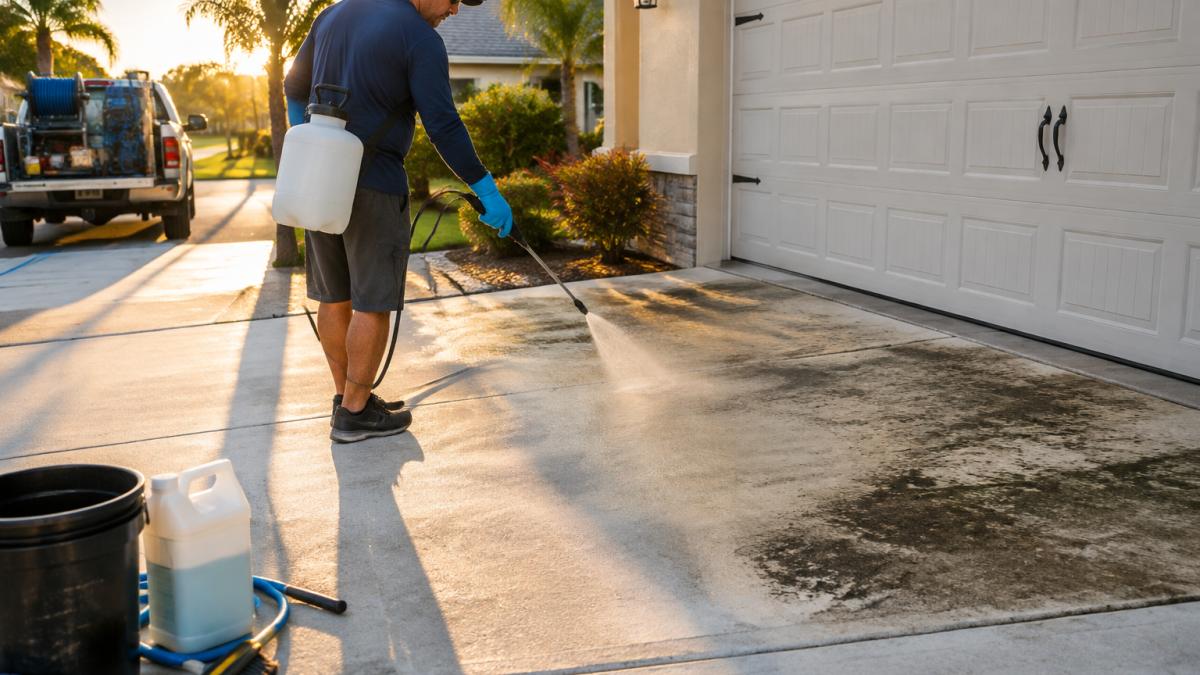
- Clear the surface. Sweep off leaves, dirt, and debris so the cleaner reaches the concrete, not the layer on top of it. Mold feeds on pollen and organic film, so a dry-brush pass first lets the chemistry work on growth rather than on loose debris.
- Pre-wet surrounding plants and the concrete itself. Saturate grass and garden beds with plain water first so they absorb less runoff. Pre-wetting the concrete also stops a thirsty slab from pulling the active ingredient out of solution before it can act, a common cause of streaky results on hot afternoons.
- Dilute according to label. Some formulas are ready-to-use; others, like bleach-based mixes, call for dilution. Follow the bottle, not guesswork. A common pattern is one part cleaner to three or four parts water for maintenance strength, but the label is the only number that matters for your product.
- Apply evenly in sections. Use a pump sprayer or pressure washer detergent tank, working in sections so nothing dries before you finish. Keep the sprayer tip low and the pattern overlapping; a fan spray from waist height wastes product to wind and drift.
- Respect dwell time. Let the product sit per the label, typically a few minutes for fast-acting formulas. Don’t let it dry on the surface. If the edge of a section starts to dry before you reach it, mist it lightly with plain water to keep the chemistry active.
- Agitate where growth is rooted. For black colonies that have worked into pores, a stiff nylon brush or a rotary surface cleaner on low pressure lifts the dead growth without etching the concrete. Avoid wire brushes, which scratch the finish and give mold a rougher surface to grip next season.
- Rinse thoroughly. Wash residue away from storm drains and landscaping. Rinse from the top of the slope down, and keep the hose moving so diluted runoff doesn’t pool against the garage door or foundation.
- Treat for prevention. Follow with a spore-control product once the surface is dry. This is the step most homeowners skip, and it is the reason the same driveway turns black again every season.
Watch out: applying cleaner in direct midday sun causes it to evaporate before it works, and it can leave permanent streaks on hot concrete. Surface temperatures above roughly 85°F accelerate evaporation and shorten effective dwell time, so early morning or late afternoon is the safer window. The same caution applies to pool deck cleaning, where runoff into the water is a separate concern, and to house wash and exterior home cleaning, where overspray onto siding or trim can discolor paint if the product is left to dry.
For the right brushes, sprayers, and scrubbing tools, see our guide to manual driveway cleaning tools. And once the mold is gone, sealing protects the surface from future growth; our walkthrough on sealing a concrete driveway yourself covers the steps. If your driveway is paved with interlocking pavers rather than poured concrete, paver sealing is a different job, the joint sand needs stabilizing before any sealer goes down, and the wrong product can trap moisture and haze the surface.
When to Call a Professional Driveway Cleaning Service Near Me
Some jobs are weekend projects. Others are better handled by a crew with the right equipment, and knowing the difference saves you money and frustration.
The DIY case. A pump sprayer, a stiff brush, and a bottle of cleaner can handle routine maintenance on a single-car driveway. The trade-off is time and risk: bleach-based products can etch concrete if left too long, peroxide formulas struggle against heavy growth, and pressure washing above roughly 3,000 PSI can strip the surface paste, expose aggregate, and drive water into cracks where freeze-thaw or root intrusion makes it worse.
The professional case. Concrete, pavers, and pool decks all have different tolerances, and a crew that cleans all three routinely reads those tolerances faster than a first-time DIYer.
Call a professional when:
- The growth covers a large area or has returned within a single season despite treatment.
- The driveway is steep, drains poorly, or slopes toward the garage or foundation.
- The surface is interlocking pavers, where joint sand stabilization and paver sealing are part of the job and a pressure washer can wash out the bedding sand.
- Your HOA has set a compliance deadline and a failed DIY attempt isn’t an option.
- The scope extends beyond the driveway, soft wash roof cleanings, house wash and exterior home cleaning, and pool deck cleaning all involve surfaces where the wrong pressure or chemistry causes damage that costs more to fix than the cleaning itself.
The maintenance math. A one-time deep clean resets the surface, but mold and mildew return wherever moisture, shade, and organic film persist. A recurring plan, monthly, quarterly, or seasonal, keeps growth from re-establishing and protects curb appeal and resale value between visits. For snowbirds and property managers who aren’t on site full-time, that recurring schedule is the difference between a driveway that looks maintained year-round and one that needs a rescue clean every spring.
At Freedom Wash Club, we’ve handled South Florida driveways for over a decade, where heat and humidity push mold growth year-round. Our licensed and insured team handles driveway cleaning, paver sealing, soft wash roof cleanings, house wash and exterior home cleaning, and pool deck cleaning, with easy scheduling by phone or text. If you’re weighing the decision, our professional driveway cleaning service guide walks through what to expect.
Frequently Asked Questions
What is the best way to kill mold on a concrete driveway?
The most effective method combines a chemical cleaner with physical removal. Pressure washing can remove surface growth and stains from concrete. For a gentler approach, a non-caustic cleaner can be applied and allowed to weather over time. Always test a small area first and wear protective gear. After cleaning, consider a sealer to prevent regrowth.
Does pressure washing remove mold and mildew from driveways?
Pressure washing removes surface mold and mildew, but it may not kill the organism at its root. For lasting results, pre-treat with a mold-killing cleaner, then pressure wash to remove stains and debris. A final low-pressure rinse helps wash away residual spores.
How often should you clean your driveway to prevent mold growth?
In humid climates like South Florida, clean your driveway every 6-12 months to prevent mold and mildew buildup. High-traffic areas or shaded driveways may need cleaning every 3-4 months. Regular cleaning removes organic debris that feeds mold. After cleaning, applying a paver sealer or concrete sealer adds a protective barrier that slows regrowth and makes future cleanings easier. Check for regrowth after heavy rains.
Are eco-friendly driveway cleaners effective against mildew?
Yes, but they work differently. Botanical or peroxide-based cleaners can be used as an alternative to bleach-based products. For heavy infestations, start with a bleach-based cleaner, then switch to an eco-friendly maintenance product. Always follow label directions for dilution and rinsing.
When should you hire a professional for driveway mold removal?
Consider hiring a professional if mold keeps returning after DIY cleaning or if you lack the time or equipment for safe chemical handling. Professional services can include paver sealing, soft wash roof cleanings, house wash and exterior home cleaning, and pool deck cleaning. For HOA compliance or pre-sale prep, a pro ensures consistent results.
Mold on concrete doesn’t fix itself, and every season you wait makes the staining harder to reverse. Freedom Wash Club offers licensed and insured exterior cleaning with a 100% satisfaction guarantee, easy phone or text scheduling, and no in-person estimate needed. Get started with Freedom Wash Club and restore your property’s curb appeal before the next growth cycle sets in.