Table of Contents
- Understanding Your HOA’s Repair Responsibilities
- Soft Wash Roof Cleaning and HOA Maintenance Standards
- Preventive Maintenance for HOA Properties: The Cost-Saving Approach
- How to Resolve HOA Maintenance Disputes Effectively
- Submitting an HOA Exterior Maintenance Request Letter
- Funding Options and Special Assessments
- Evaluating Contractor Bids and Avoiding Poor-Quality Work
- Frequently Asked Questions
Last Updated: October 6, 2026
Understanding Your HOA’s Repair Responsibilities
Homeowners associations manage common areas and set maintenance standards that affect property values, with HOA exterior repairs ranging from routine maintenance to major structural work.
Your HOA governing documents, typically CC&Rs (Covenants, Conditions, and Restrictions) or bylaws, define who pays for what by spelling out which exterior elements are “common areas” and which remain “owner-maintained property.”
Common Areas vs. Owner-Maintained Property
Common areas are shared elements that benefit all residents, the roof structure, foundation, exterior walls, siding, and main plumbing or electrical systems serving multiple units.
Owner-maintained property includes your individual driveway, patio, deck, and any exterior elements serving only your unit. You pay for these repairs directly, making preventive maintenance your best defense against costly bills.
Routine Maintenance vs. Major Repairs
HOAs handle routine maintenance and major repairs differently.
Major repairs involve replacing or significantly fixing structural elements, a new roof, foundation work, or siding replacement, funded through reserves or special assessments.
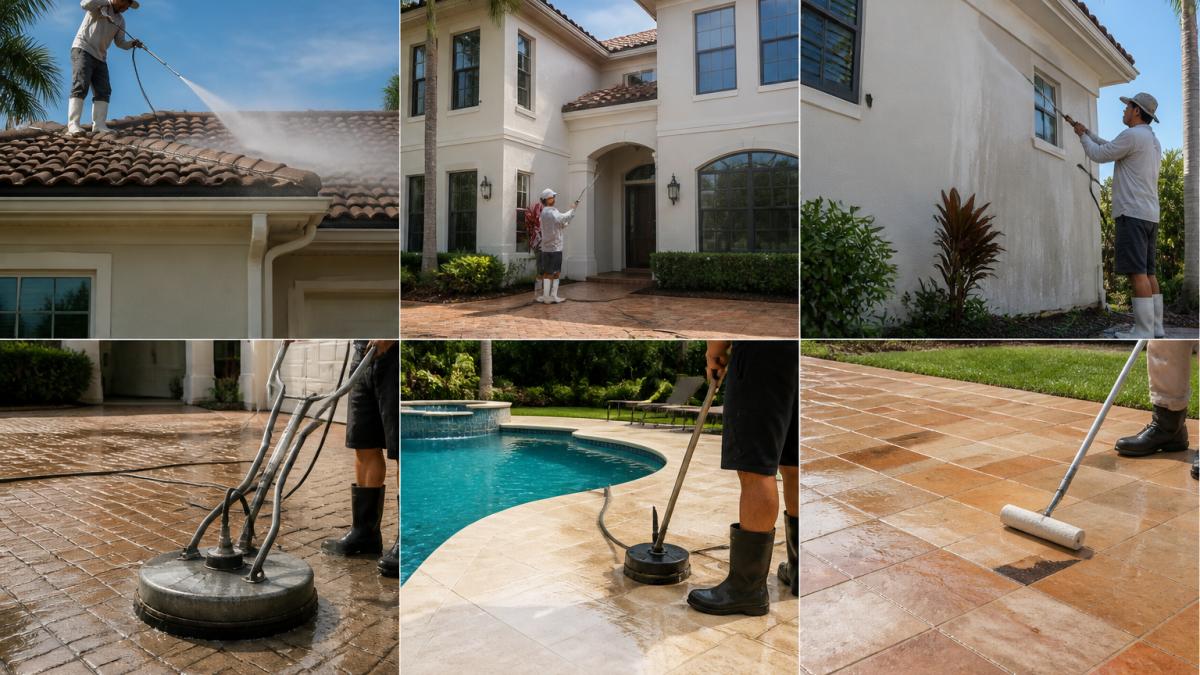
The real cost-saving opportunity lies in routine maintenance: a soft wash roof cleaning removes damaging mold and algae before they compromise the roof structure, and regular driveway cleaning prevents permanent stains.
Soft Wash Roof Cleaning and HOA Maintenance Standards
Roof cleaning is one of the most overlooked preventive maintenance tasks.
A soft wash roof cleaning uses low-pressure water and specialized solutions to remove buildup without damaging shingles or tiles.
Many HOAs include roof appearance in their maintenance standards, and discolored roofs can trigger fines.
At Freedom Wash Club, we’ve helped countless South Florida homeowners and HOAs maintain roof condition with regular soft wash cleanings.
Preventive Maintenance for HOA Properties: The Cost-Saving Approach
The best way to manage expensive HOA exterior repairs is to stop them from becoming necessary. Preventive maintenance costs a fraction of major repairs, yet many homeowners skip it until a problem becomes critical.
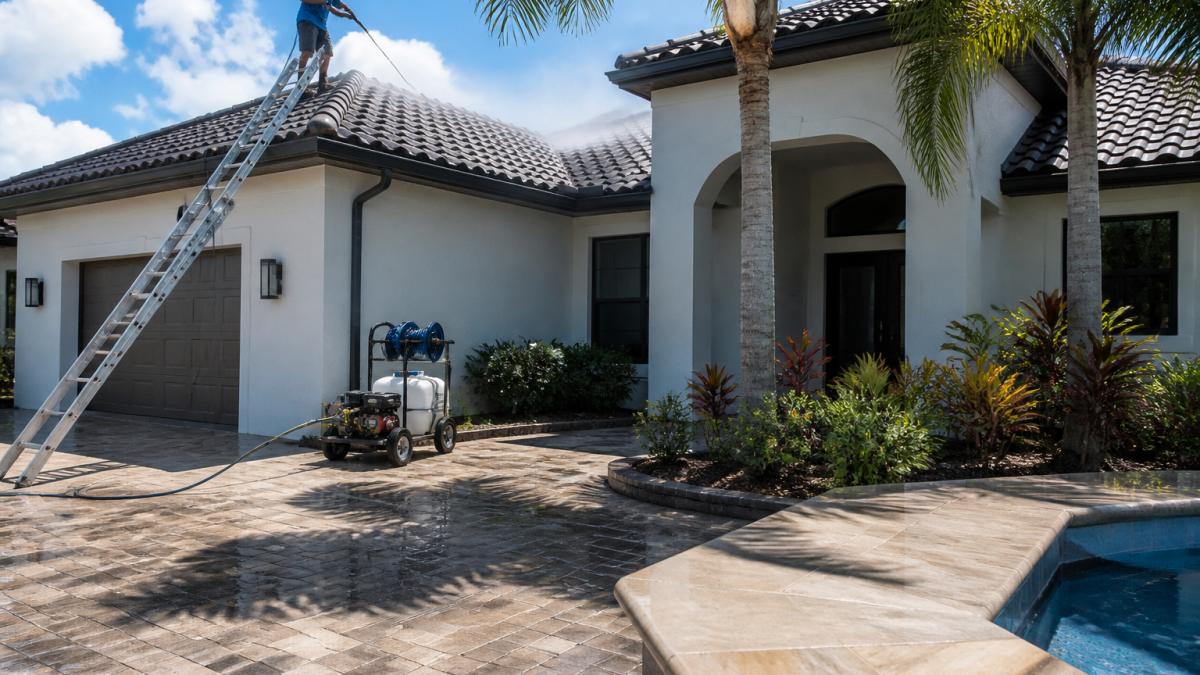
Preventive maintenance includes key tasks that protect your property and keep you HOA-compliant:
- Regular cleaning removes damaging substances before they cause permanent staining or structural issues
- Seasonal inspections catch small problems before they become expensive ones
- Timely repairs address minor issues before they spread to surrounding areas
The cost difference is dramatic. A driveway cleaning runs a fraction of a full driveway replacement, paver sealing protects your investment for years, and a soft wash roof cleaning prevents the eventual need for a complete roof replacement, one of the most expensive HOA assessments homeowners face.
Driveway Cleaning and Pool Deck Maintenance
Driveways and pool decks take constant abuse from weather, salt spray, and daily use.
Professional driveway cleaning removes these contaminants and restores the surface. Once stains bond chemically to concrete, they become nearly impossible to remove, which is why early cleaning is cost-effective.
Pool decks require similar attention. Algae and mold make surfaces slippery and unsafe, so regular cleaning maintains safety while preventing costly resurfacing or replacement.
House Wash and Exterior Home Cleaning
Your home’s exterior, siding, walls, windows, and trim, accumulates dirt, mold, and algae that degrade appearance and structural integrity. House wash removes these contaminants and restores curb appeal.
Freedom Wash Club provides professional house wash and exterior home cleaning designed for South Florida properties, handling mold removal safely to prevent the spread that leads to costly repairs.
Paver Sealing to Extend Surface Life
Pavers, patios, and driveways made from natural stone or concrete benefit enormously from sealing. Paver sealing protects the surface from moisture penetration, staining, and UV damage.
Sealed pavers last significantly longer than unsealed ones.
Paver sealing costs a fraction of replacing damaged pavers or resurfacing an entire patio, paying for itself through extended surface life.
How to Resolve HOA Maintenance Disputes Effectively
Disputes between homeowners and HOA boards often stem from unclear communication about maintenance responsibilities. Before escalating, try these steps.
First, review your governing documents.
Second, request a written explanation from the HOA board if you disagree with a maintenance notice or assessment, asking them to cite the specific governing document section supporting their position.
If informal resolution fails, many states allow mediation or arbitration before legal action, faster and cheaper than litigation.
Submitting an HOA Exterior Maintenance Request Letter
When you need the HOA to address common area maintenance, a formal written request creates a paper trail and forces a documented response.
What to Include in Your Request
Your request letter should include specific details:
- The problem: Describe exactly what needs attention (roof staining, foundation damage, broken gutter, etc.)
- Location: Specify which building, unit, or common area is affected
- Documentation: Attach photos showing the issue
Keep your tone professional and factual, focusing on the maintenance issue rather than the board’s past performance.
Timeline and Follow-Up Strategy
Send your request via certified mail or email with read receipt confirmation. This creates proof of delivery.
If you don’t hear back, send a follow-up referencing your original request and its date.
If the board doesn’t respond within 30 days, check your state’s HOA laws, many require written responses within specific timeframes.
Funding Options and Special Assessments
When a major exterior repair lands on the agenda, the board must answer two questions: how does the association pay for it, and how do owners who didn’t budget for it absorb their share?
Side-by-Side Comparison of Repair Funding Options
| Funding Source | Who Controls It | Typical Timing | Main Risk | Best Used For |
|---|---|---|---|---|
| Reserve fund | Board, per reserve study | Immediate if fully funded | Depletes reserves for the next project | Planned repairs already in the reserve schedule |
| Special assessment | Board vote, sometimes owner vote | Weeks to months to collect | Owner hardship, delinquency, liens | Urgent repairs with no reserve coverage |
| Association loan or line of credit | Board | Weeks to close | Interest cost; lender underwriting | Spreading a large one-time cost over years |
| Payment plan for owners | Board policy | Immediate, spread over months | Administrative burden; default risk | Helping owners absorb an assessment |
| Owner-funded work on owner-maintained property | Individual owner | As needed | No shared cost relief | Driveways, patios, decks, and other owner-maintained surfaces |
| Grants or municipal programs | Outside agency | Long, competitive | Eligibility limits; application burden | Specific eligible improvements, when available |
A reserve study tells the board whether a repair should have been funded already. If the study is current and the reserve account healthy, no special assessment should be needed; if the study is stale or the account underfunded, the assessment is the symptom, not the cause.
How Special Assessments Actually Work
A special assessment is a charge levied on every owner to cover a cost the operating budget and reserves cannot absorb.
Assessments are usually collected as a lump sum due by a date certain, installments over a defined period, or a combination. The collection method matters as much as the amount, because a lump sum is what pushes owners into hardship.
A special assessment is a debt tied to the unit. Unpaid assessments can lead to late fees, interest, collection costs, and in many cases a lien on the property. If you cannot pay, address it with the board early rather than letting it age.
Options for Owners Who Cannot Afford an Assessment
If an assessment arrives and the number isn’t payable on the stated date, you have more options than defaulting.
- Request a payment plan in writing. Many boards have a standard hardship or installment policy. Ask for the policy, then ask to be placed on it, and keep a copy.
- Ask about a hardship deferral. Some governing documents and state statutes allow a deferral for owners meeting defined criteria. The criteria are narrow, but they exist.
- Request mediation. If the board refuses a reasonable plan and the dispute escalates, many states provide a mediation or alternative dispute resolution path before foreclosure or lien enforcement.
Preventive maintenance is the cheapest funding strategy there is. A soft wash roof cleaning, regular driveway cleaning, house wash and exterior home cleaning, pool deck cleaning, and paver sealing all cost a fraction of the repairs they prevent, and they keep the association out of the special-assessment cycle in the first place.
What Boards Should Do Before Assessing
Before voting on an assessment, a well-run board confirms the reserve study is current, gets at least three contractor bids, phases the work if possible so the first assessment is smaller, and adopts a written payment plan policy. Boards that skip these steps see higher delinquency, more disputes, and slower collection.
Evaluating Contractor Bids and Avoiding Poor-Quality Work
On HOA-scale exterior work, the bid is the scope, not the price. Two contractors can quote very different numbers for the same-sounding job because one is replacing sheathing or including a soft wash roof cleaning as prep and one is not. Comparing bottom lines without comparing scope is how boards end up paying twice.
Compare Scope, Not Just Price
Put every bid into the same line-item format before comparing. At minimum, each bid should break out:
- Demolition and prep, what is removed, what is protected, what is cleaned before work starts
- Materials, brand, grade, and quantity, not just “like kind”
- Surface prep and cleaning, for exterior work this often includes house wash and exterior home cleaning, driveway cleaning, pool deck cleaning, and paver sealing where those surfaces are part of the scope
A bid that is silent on a line item is not necessarily cheaper, it is undefined. Undefined scope is where change orders come from.
Licensing, Insurance, and Verification
Ask for the contractor’s license number and verify it with the state licensing authority. Ask for a certificate of insurance showing general liability and workers’ compensation, then call the insurer to confirm it’s active, certificates can be altered or expired.
If the contractor uses subcontractors, confirm they carry their own coverage. An uninsured sub who gets hurt on your property is a problem the association inherits.
References, Warranties, and Change Orders
Call at least three references from jobs completed in the last two years, asking about punch-list items, how problems were handled, and whether the final invoice matched the bid.
Read the warranty language carefully. A “lifetime” materials warranty is not a workmanship warranty, and many manufacturer warranties are voided if the installer wasn’t certified.
Change orders are the most common source of cost overruns.
On phased exterior work, insist that each phase be inspected and signed off before the next phase begins. This catches poor workmanship while it is still cheap to fix and keeps payments tied to completed, verified work.
Red Flags That Predict Poor Work
- Pressure to sign immediately or a “today only” price
- Requests for large cash payments or payment in full up front
- No physical business address, or a phone number that only reaches a cell
How Preventive Services Fit Into the Bid Process
When the scope includes exterior surfaces, ask each bidder to price preventive services separately from the repair work. Soft wash roof cleanings, house wash and exterior home cleaning, driveway cleaning, pool deck cleaning, and paver sealing are often cheaper bundled with a repair than scheduled later, and bundling keeps surfaces under warranty conditions.
Frequently Asked Questions
What’s the difference between routine maintenance and major repairs in an HOA?
Routine maintenance includes regular cleaning, landscaping, and minor repairs that preserve property condition, like soft wash roof cleaning or driveway cleaning to prevent deterioration. Major repairs involve structural work, roof replacement, or foundation repairs that require reserve funds or special assessments. Your governing documents define which category each repair falls into. Routine maintenance is typically budgeted annually, while major repairs may require reserve studies and advance planning to distribute costs fairly.
Can preventive maintenance for HOA properties actually reduce special assessments?
Yes. Regular preventive maintenance, including paver sealing, house wash and exterior home cleaning, and soft wash roof cleaning, slows deterioration and extends the life of surfaces and systems. When an HOA invests in these practices consistently, major repairs are delayed or avoided entirely, reducing the need for expensive special assessments. Many HOAs find that spending modest amounts on preventive care saves thousands in emergency repairs later. Document maintenance activities to justify budget allocations to your board.
What should I include in an HOA exterior maintenance request letter?
Include specific details: the location and description of the problem, photos if possible, the date you first noticed the issue, and how it affects property value or safety. Reference relevant sections of your CC&Rs or bylaws that require the HOA to address it. Explain the urgency (is there water damage risk?) and request a timeline for inspection and repair. Keep the tone professional and factual. Submit the letter in writing (email or certified mail) so you have proof of delivery. Follow up if you don’t receive a response within 30 days.
How do I know if a contractor bid for HOA exterior repairs is reasonable?
Get at least three bids from licensed, insured contractors for the same scope of work. Compare what each bid includes, materials, labor, timeline, and warranty. Check references and verify licensing with your state. Watch for bids that are unusually low (often a sign of corner-cutting) or vague about what’s included. Ask contractors to explain their pricing and methodology. A reputable contractor should be transparent about why their price is what it is and willing to answer questions about quality and durability.