
Last Updated: November 18, 2026
Quick Summary
A seasonal home exterior preservation checklist is a recurring inspection and cleaning schedule that catches small exterior problems before they become structural repairs. Rotate tasks across four seasonal blocks, log pass/fail results, and schedule the next date before finishing each task.
- Spring is the key inspection window for roof, gutters, and siding after the wet season.
- Summer focuses on driveway cleaning, pool deck care, and paver sealing before growth sets in.
- Fall is the time to inspect windows, doors, caulking, and weatherstripping.
- Log observations the same day and photograph any fail item for a dated record.
- Any fail item gets a follow-up date within 30 days.
Table of Contents
- Why Seasonal Home Exterior Preservation Beats Reactive Repairs
- Your Home Maintenance Checklist by Month: A 12-Month Rotation
- Spring: Roof, Gutters, and Siding Inspection After the Wet Season
- Summer: Driveway Cleaning, Pool Deck Care, and Paver Sealing
- Fall: Windows, Doors, and Caulking Before the Cooler Months
- Winter Home Exterior Maintenance Checklist for South Florida Properties
- Printable Seasonal Home Exterior Maintenance Checklist and Recordkeeping
- Get Your Free Quote and Put the Checklist to Work
- Frequently Asked Questions
Why Seasonal Home Exterior Preservation Beats Reactive Repairs
A seasonal home exterior preservation checklist is a recurring inspection and cleaning schedule that catches small exterior problems before they become structural repairs.
Reactive repairs cost more because moisture works on a problem for months before you notice it. Organic growth on a roof, a clogged downspout, or a hairline caulk crack all start small, then turn into rot, staining, or water intrusion after a wet season.
Below, we break the year into four workable blocks, with a home maintenance checklist by month, pass/fail inspection criteria, and a printable seasonal home exterior maintenance checklist.
Your Home Maintenance Checklist by Month: A 12-Month Rotation
The most useful home maintenance checklist by month groups tasks into four seasonal blocks rather than twelve separate months. South Florida’s wet season runs roughly May through October; the drier stretch from November through April is when exterior work holds best.
Here is how we would rotate the work:
| Season | Core Exterior Tasks | Frequency | Risk if Skipped |
|---|---|---|---|
| Spring | Roof, gutter, and siding inspection | Once, after the wet season | Missed shingle damage, overflow staining |
| Summer | Driveway cleaning, pool deck care, paver sealing | Once, plus light rinsing | Slippery surfaces, set-in organic stains |
| Fall | Windows, doors, caulking, weatherstripping | Once | Water intrusion, higher cooling costs |
| Winter | Full exterior walkthrough, records update | Once, plus quarterly checks | Undetected damage through the dry season |
Two things separate a working schedule from a wish list: write down what you did and when, and put the next date on a calendar before you finish the current task.
Spring: Roof, Gutters, and Siding Inspection After the Wet Season
Spring is the most important inspection window: the wet season has just pushed water against every surface, and damage is easiest to spot now.
Start with the roof. From the ground with binoculars, look for lifted, cracked, or missing shingles, dark streaking, and granule buildup in the gutters.
Next, walk the gutters and downspouts. Clear debris, then run a hose to confirm water exits at the ground and away from the foundation. Sagging sections and rusted seams are fails.
Finally, check siding and trim for bubbling paint, soft spots, and green or black growth on north-facing walls. For the interval question, see our guide on how often to soft wash a roof in South Florida.
Summer: Driveway Cleaning, Pool Deck Care, and Paver Sealing
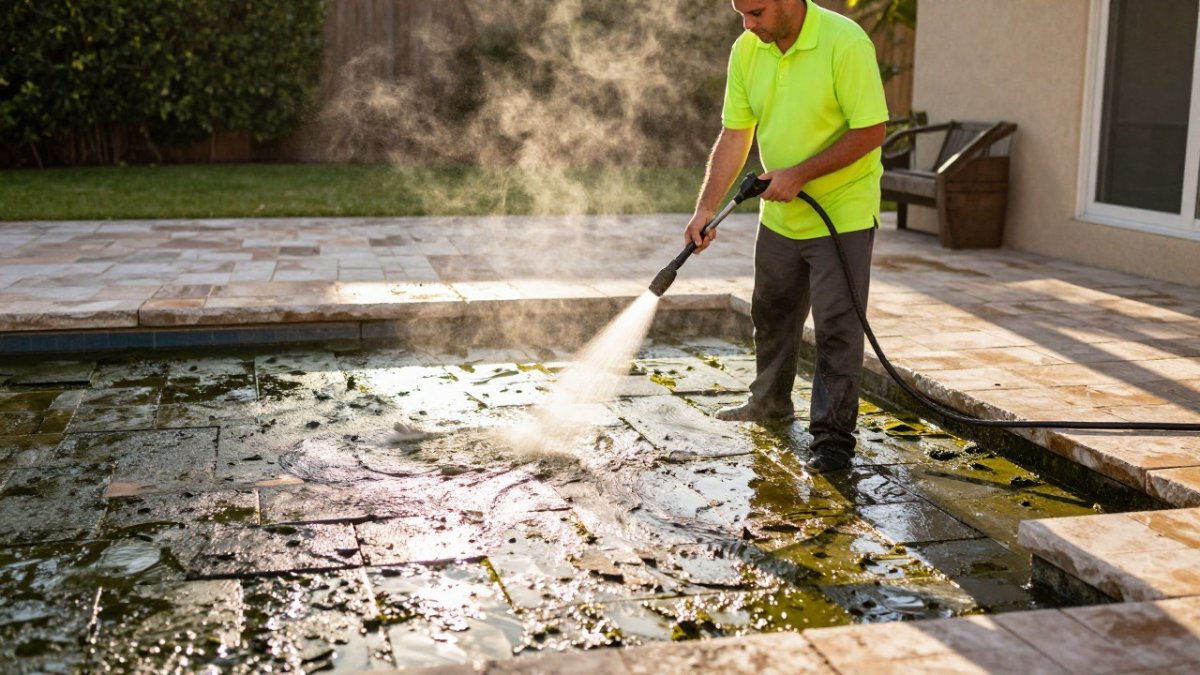
Summer is when exterior hardscape takes the most abuse. Intense sun, afternoon storms, and constant moisture create perfect conditions for algae, mold, and slippery film on concrete and pavers.
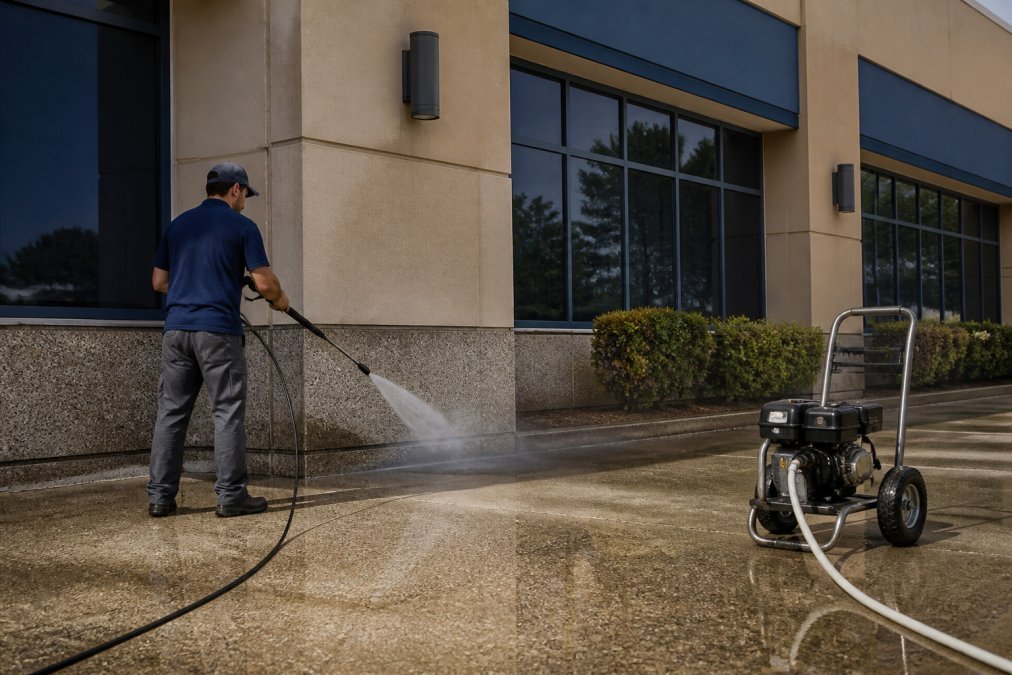
Driveway cleaning should happen before growth sets into the surface. For a full walkthrough of when to hire out, see our professional driveway cleaning service guide.
Pool deck care follows the same logic. Our pool deck cleaning best practices explain how to protect the surface while getting the growth off.
Paver sealing is the step most homeowners skip and later regret. Sealing locks out moisture, slows organic regrowth, and keeps joint sand in place; our breakdown of paver sealing benefits for Florida homes covers what sealing does and does not do.
Fall: Windows, Doors, and Caulking Before the Cooler Months
Fall is the window and door season, and the reason is simple: this is your last easy stretch to seal the envelope before cooler, drier air settles in.
The National Association of Home Builders routine home maintenance guide recommends inspecting exterior windows and doors yearly for cracked or split caulking and cleaning mildew as part of a routine schedule. That matches what we see in the field.
Work through the openings methodically:
- Run a finger along every caulk bead and flag gaps, cracks, or separation.
- Check weatherstripping at doors for compression loss and daylight gaps.
- Clean mildew from frames with a mild solution before recaulking.
- Replace failed caulk with an exterior-grade sealant rated for your material.
- Confirm window screens and weep holes are clear.
Then step back and inspect exterior paint on trim and fascia. Peeling or blistering paint is a moisture signal, not just a cosmetic one.
Winter Home Exterior Maintenance Checklist for South Florida Properties
Winter exterior maintenance is not one checklist, it is a climate-adjusted rotation.
Step 1: Identify your winter risk profile.
- Freeze-thaw climate (Northeast, Midwest, Mountain West): The priority is water management before the first hard freeze. Disconnect hoses, shut off and drain exterior faucets, and confirm downspouts discharge at least 4-6 feet from the foundation. Ice dams form when warm attic air melts snow that refreezes at the eaves, check attic insulation and ventilation now, not after the first snowfall.
- Heavy snowfall climate (Snow Belt): Roof snow load and ice dam risk dominate. Clear gutters before the first snow so meltwater has a path. Inspect the roof from the ground with binoculars for lifted shingles or flashing gaps that snowmelt can exploit. Keep foundation vents and dryer vents clear of drifting snow.
- Persistent rain climate (Pacific Northwest, Gulf Coast): Winter is your wet season. Prioritize gutter flow, siding clearance above grade, and caulk integrity around windows and doors. Organic growth on north-facing surfaces tends to accelerate in constant moisture, so scheduling exterior cleaning before the rainy stretch can help prevent staining.
- Dry-season climate (Southwest, South Florida): The risks are dust, windblown debris, and unnoticed damage during extended absences. Clear roof valleys and gutters of debris, rinse siding and screen enclosures of dust and pollen film, and check hardscape for new organic growth. If you leave for the season, schedule a professional exterior cleaning and inspection before departure and arrange quarterly walkthroughs.
Step 2: Prioritize tasks by risk and urgency.
Label every winter task as safety-critical, preventive, or cosmetic. Safety-critical tasks, loose railings, damaged roof flashing, blocked dryer vents, get fixed first.
Step 3: Use pass/fail inspection criteria.
- Roof: Pass means shingle edges sit flat and flashing is sealed. Fail means any lifted, cracked, or missing shingle, or visible daylight through roof decking from the attic.
- Gutters and downspouts: Pass means water exits at the ground and away from the foundation during a hose test. Fail means sagging sections, rusted seams, or water pooling at the foundation.
- Exterior faucets: Pass means the shutoff valve inside the house holds and the outdoor spigot drains fully. Fail means any drip after shutoff, that is a freeze-break waiting to happen.
- Siding and trim: Pass means paint is intact and trim is firm. Fail means soft spots, bubbling paint, or green/black growth that survives a rinse.
Step 4: Know when to call a professional.
Any roof work above a single story, electrical fixture inspection, or repair involving the structural envelope is best left to licensed professionals.
In mild-winter regions, winter can be a suitable time to schedule paver sealing and pool deck cleaning, since surfaces are often drier.
Printable Seasonal Home Exterior Maintenance Checklist and Recordkeeping
A checklist only works if it captures what you found, not just what you did. Use this tracker to log each task, record pass/fail observations, and set the next due date.
How to use the tracker: For each task, write the date completed, a pass/fail mark, notes on any damage or change, and the next due date.
| Task | Pass Criteria | Fail Criteria | Date | Pass/Fail | Notes | Next Due |
|---|---|---|---|---|---|---|
| Roof inspection (ground level, binoculars) | Shingle edges flat, no dark streaking, flashing sealed | Lifted/cracked/missing shingles, visible organic growth, granule buildup in gutters | ||||
| Gutter and downspout flow test | Water exits at ground and away from foundation | Sagging, rusted seams, overflow staining, pooling at foundation | ||||
| Siding and trim check | Paint intact, trim firm, no growth after rinse | Soft spots, bubbling paint, green/black growth | ||||
| Window and door caulk inspection | Beads continuous, adhered, flexible | Cracks, separation, chalky texture | ||||
| Weatherstripping check | Door seals compress, no daylight gaps | Compression loss, visible daylight | ||||
| Exterior paint review | Uniform finish, no blistering | Peeling, blistering, exposed substrate | ||||
| Driveway and hardscape rinse | Surface lightens evenly, no slick feel | Dark staining survives rinse, black spotting in joints | ||||
| Pool deck algae check | No visible film, safe underfoot | Algae film, slip hazard | ||||
| Paver joint sand check | Joints full, pavers stable | Sand loss, loose pavers, weeds in joints | ||||
| Exterior faucet drain (cold climates) | Valve holds, spigot drains fully | Drip after shutoff | ||||
| Downspout discharge check | Water directed 4-6 feet from foundation | Water pools near foundation | ||||
| Attic vent and exterior vent clearance | Vents clear of debris, screens intact | Blocked vents, damaged screens, pest entry |
Recordkeeping that pays off:
- Insurance claims: A dated log showing routine maintenance and prompt repairs can help document that damage was not due to neglect.
- Resale: Buyers and inspectors often view maintenance records as evidence of care.
- Warranty compliance: Some roofing and siding warranties may require documented maintenance, so keeping receipts and dates is worthwhile.
Follow-up system: At the end of each season, review the tracker and schedule the next season’s tasks.
Watch out: Filling in the tracker from memory weeks later defeats the purpose.
Get Your Free Quote and Put the Checklist to Work
The checklist above is only as good as the follow-through.
That is where we come in. Freedom Wash Club is licensed and insured, locally owned and operated in South Florida, with more than a decade of experience.
Get started with Freedom Wash Club and put your exterior on a schedule that protects its value year-round. You can get an instant quote for roof cleaning and we will take it from there.
Your exterior does not need more effort. It needs a rhythm. Pick one season to start, run the inspection honestly, and hand the heavy cleaning to a team that does it every week.
Frequently Asked Questions
What are the most important seasonal home exterior maintenance tasks?
Focus on water management and organic growth. Inspect the roof for damaged shingles and streaking, clean gutters and downspouts, check caulking around windows and doors, and look for peeling exterior paint. In humid climates, schedule soft wash roof cleaning and house washing to remove mold and algae before they spread. Clean driveways and pool decks yearly, and reseal pavers when water stops beading. A seasonal home exterior routine that hits these items twice a year prevents most costly repairs.
How often should I inspect my home’s exterior?
Walk the exterior at least twice a year, in spring and fall, and after any major storm. Check the roof, gutters, siding, trim, windows, doors, foundation, and drainage each time. Routine home maintenance guidance commonly recommends inspecting exterior windows and doors yearly for cracked or split caulking and cleaning mildew. Keep a simple log of what you find so you can spot recurring issues, like a downspout that overflows every rainy season.
What exterior maintenance should I do before winter?
Clear gutters and downspouts of debris, confirm grading slopes away from the foundation, and check that caulking and weatherstripping seal gaps. Inspect the roof for loose or missing shingles and trim trees away from the roofline. In cooler regions, drain hose bibs and outdoor faucets to prevent freeze damage. In South Florida, winter is the dry season, so use it to schedule soft wash roof cleaning and house washing before spring rains return.
How do I maintain a driveway and pool deck throughout the year?
Sweep weekly, rinse spills promptly, and remove leaves and dirt before they stain. Pressure wash the driveway and pool deck at least once a year, more often under trees or near irrigation sprinklers that leave mineral deposits. Reseal pavers every two to three years, or sooner if water no longer beads. If you see dark streaks or green film, that is mold or algae and needs treatment, not just a rinse. Professional driveway cleaning and pool deck cleaning restore the surface safely.
When should I schedule soft wash roof cleaning?
Schedule soft wash roof cleaning as soon as you see dark streaks, green film, or moss, and at least once a year in humid climates. Soft washing uses low pressure and a cleaning solution, which is generally considered gentler on shingles than high-pressure blasting. Spring, before the rainy season, is ideal so the roof stays clean longer. Pair it with house washing to remove the same growth from siding and eaves.