Table of Contents
- Pressure Washing for Commercial Buildings: What You Need to Know
- Top Equipment Options for Commercial Pressure Washing
- Soft Washing vs Pressure Washing for Commercial Buildings
- Understanding Commercial Pressure Washing Cost Per Square Foot
- Hiring a Licensed and Insured Pressure Washing Company
- Critical Specifications: PSI, GPM, and Pump Selection
- Maintenance, Safety, and Regulatory Compliance
- Frequently Asked Questions
Last Updated: August 31, 2026
Pressure Washing for Commercial Buildings: What You Need to Know
Commercial property maintenance demands more than basic cleaning. When dirt, mold, algae, and grime accumulate on building facades, parking lots, and entryways, damage compounds quickly. Stains set deeper into concrete, mold spreads faster across roofing materials, and restoration becomes harder and more expensive.
The best pressure washing for commercial buildings combines the right equipment specifications, technique selection, and professional execution to restore surfaces without causing damage. At Freedom Wash Club, we’ve spent over a decade managing commercial properties across South Florida, and we’ve learned which approaches actually work versus which ones create costly mistakes.
This guide covers what separates effective commercial pressure washing from amateur attempts. You’ll learn the specific PSI and GPM requirements that matter, when to use soft washing instead of high pressure, and how to evaluate whether hiring a licensed professional makes financial sense versus equipment ownership.
Commercial pressure washing isn’t about maximum PSI, it’s about matching the right pressure, flow rate, and technique to each surface type. The costliest mistakes happen when contractors use one-size-for-all approaches.
Top Equipment Options for Commercial Pressure Washing
Commercial-grade equipment differs fundamentally from consumer models. The difference isn’t just power, it’s reliability, longevity, and the ability to handle back-to-back jobs without thermal failure or pump breakdown.
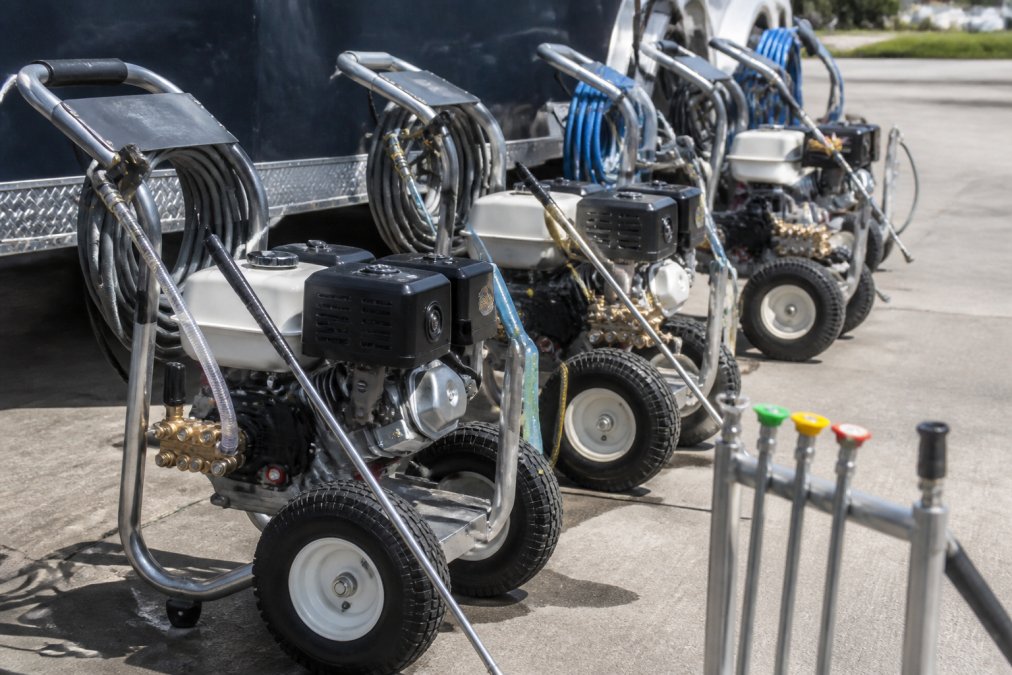
1. Simpson Cleaning ALH4240 (4200 PSI / 4.0 GPM)
The Simpson ALH4240 represents the workhorse standard for contractor-level commercial pressure washing. It delivers 4200 PSI with 4.0 GPM flow rate, powered by a Honda GX390 engine. The aircraft-grade aluminum frame keeps weight manageable while maintaining durability on job sites.
The AAA industrial triplex pump handles consistent pressure across extended cleaning sessions. The 4.0 GPM flow rate matters more than raw PSI for most commercial applications, higher water volume means faster surface coverage and better dirt suspension. Quick-connect nozzles let you switch between 0-degree, 15-degree, 25-degree, and 40-degree patterns without stopping the engine.
Gas-powered equipment requires fuel management and regular maintenance. Cold water only limits effectiveness on grease and oil-heavy surfaces. At this PSI level, operator error easily damages softer surfaces like brick or stucco.
The thermal relief valve prevents pump damage during idle periods. Check this valve monthly; it’s the first component to fail under neglect.
Best for: Concrete restoration, parking lot cleaning, heavy-duty commercial facades where high PSI is appropriate.
2. DeWalt 3300 PSI Commercial Series
DeWalt’s commercial series targets contractors who prioritize longevity and low downtime. The 3300 PSI rating paired with a premium Honda GX engine and industrial triplex pump creates a balanced platform for extended commercial use.
This unit excels at paint preparation and fleet washing, jobs where consistent pressure matters more than peak power. The oversized pneumatic tires and steel frame design make transport across uneven job sites easier than lighter aluminum alternatives.
The limitation: 3300 PSI sits below the threshold for heavily stained concrete or thick algae removal on roofing. If your primary work involves soft washing or delicate surfaces, you’re overpaying for unnecessary pressure.
Best for: Paint prep, fleet washing, contractors running multiple jobs weekly who need reliable equipment.
3. Westinghouse 3600 PSI Electric Pressure Washer
Electric pressure washers eliminate fuel logistics and emissions, a significant advantage for indoor work, noise-restricted job sites, or urban environments. The high-efficiency induction motor runs quieter than gas equivalents, enabling work in noise-sensitive areas. No fuel storage, no exhaust fumes, and maintenance drops to filter checks and hose inspection.
You’re tethered to electrical outlets. Cord length typically limits range to 50-100 feet depending on setup. For large parking lots or sprawling commercial properties, this becomes a workflow bottleneck. Cold water operation still limits effectiveness on grease.
Best for: Indoor cleaning, storefronts, equipment washing, contractors in urban zones with noise ordinances.
4. Pressure-Pro 4000 PSI Electric Start
The Pressure-Pro 4000 PSI model targets commercial users who value convenience features. Electric start eliminates manual pull-cord engagement, meaningful when starting equipment dozens of times daily. The Honda GX390 engine and General EZ4040 pump deliver reliable performance for demanding applications.
This equipment shines for contractors managing multiple job sites. The electric start reduces operator fatigue and speeds up mobilization between locations. The 4000 PSI rating handles most commercial concrete restoration without overkill.
The trade-off: Higher price point compared to base models. Gas-powered operation still requires fuel management and produces noise.
Best for: High-volume commercial contractors running 5+ jobs per week who prioritize convenience and speed.
5. Maverick 12V Soft Wash System
Soft washing represents an entirely different approach, low pressure (typically 40-60 PSI) combined with chemical application for gentle surface cleaning. The Maverick 12V system targets roofs, delicate siding, and surfaces where high-pressure damage is a liability.
The system includes a stainless steel hose reel, chemical injection capability, and 12V powered pump. Soft washing works through chemistry rather than force; cleaning agents break down biological growth and stains while low pressure rinses without erosion (peer-reviewed research).
Soft washing dominates on roof cleaning, wood restoration, delicate masonry, and any surface where pressure above 1000 PSI risks damage. The limitation: soft washing is slower than pressure washing, and you need knowledge of chemical compatibility with different surface materials.
Soft wash chemicals can damage landscaping if runoff isn’t managed. Always establish containment and rinse vegetation thoroughly post-application.
Best for: Roof cleaning, historic building restoration, contractors specializing in soft wash services.
Soft Washing vs Pressure Washing for Commercial Buildings
The choice between soft washing and pressure washing determines whether your commercial building restoration succeeds or creates new problems. These aren’t interchangeable techniques.
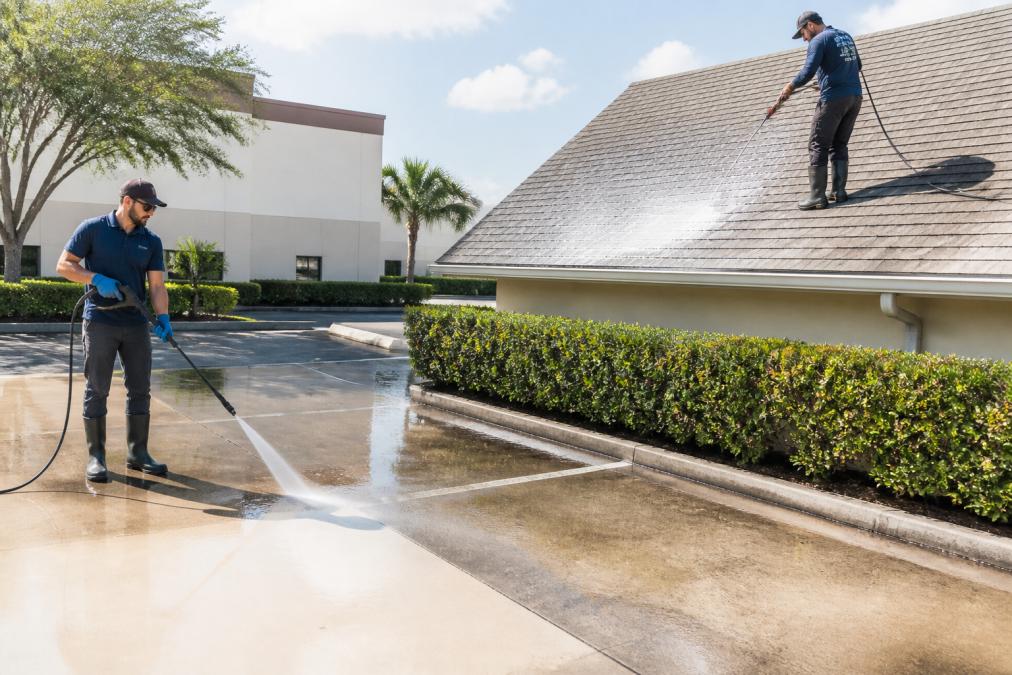
Pressure washing applies force, typically 2000-4200 PSI, to blast away dirt through mechanical action. Water volume (GPM) determines how quickly you move material. This approach works on concrete, asphalt, metal, and surfaces that tolerate impact without damage.
Soft washing applies low pressure (40-100 PSI) with chemistry. Cleaning agents do the work; water rinses. This method protects delicate surfaces like roof shingles, wood siding, stucco, and brick where pressure above 1000 PSI causes erosion or streaking.
Use pressure washing when:
- Surface is concrete, asphalt, or sealed stone
- Staining is thick and set (oil, rust, heavy algae buildup)
- Speed matters; you need the job completed in hours, not days
- Chemical damage risk is low
Use soft washing when:
- Surface is roof shingles, wood, unsealed brick, or stucco
- Biological growth (moss, algae, mold) is the primary issue
- Pressure above 1000 PSI risks surface damage
- You need stain prevention, not just removal
Most commercial buildings need both. Concrete areas benefit from pressure washing. Roofing and delicate facades require soft washing. Mixing approaches on a single property is standard practice.
Commercial property managers maintaining mixed-material buildings. Soft wash roofs and delicate areas; pressure wash concrete and sealed surfaces.
Understanding Commercial Pressure Washing Cost Per Square Foot
Pricing for best pressure washing for commercial buildings varies by surface type, contamination level, equipment access, and whether you’re buying equipment versus hiring professionals.
Equipment ownership costs:
A commercial-grade pressure washer (4000+ PSI) ranges from approximately $700 to $1,300 for gas models, $600-$800 for electric models. Add hoses, nozzles, surface cleaners, and chemical injectors; total investment easily reaches $2,000-$3,000. The Maverick soft wash system costs around $2,285.
Ownership makes sense if you’re running a commercial cleaning business. For property managers handling occasional cleaning, hiring professionals typically costs less when you factor equipment maintenance, storage, fuel, and operator training.
Professional service costs:
Pricing depends on contamination severity, surface type, and accessibility. A straightforward concrete lot cleans faster than roofing with biological growth. Steep roofs cost more due to safety equipment and labor time.
Freedom Wash Club offers flexible scheduling and custom quotes based on your specific property needs. Describe your surfaces over the phone or text, and we provide pricing aligned with your situation.
Professional services include licensed operators, insurance coverage, equipment maintenance, and satisfaction guarantees. If the job fails, they fix it. If you damage a surface with improper technique, you own the repair cost.
Hiring a Licensed and Insured Pressure Washing Company
Choosing between DIY equipment operation and professional hiring depends on complexity, liability tolerance, and time constraints.
Why licensing and insurance matter:
A licensed pressure washing company has met regulatory requirements specific to commercial cleaning. Insurance protects you if equipment damages property or injures workers. Verify licensing through your state’s licensing board. Confirm insurance coverage includes property damage and worker injury.
Red flags when evaluating contractors:
- No insurance documentation available
- Pricing significantly below market
- No references or case studies available
- Unwilling to provide written estimates
- No mention of surface assessment or technique selection
What professional contractors provide:
- Pre-job surface evaluation (identifies damage risk)
- Appropriate technique selection (pressure vs. soft wash)
- Proper chemical selection for your surface type
- Safety protocols for worker and property protection
- Satisfaction guarantees
Freedom Wash Club brings 10+ years of commercial experience, licensed and insured operation, and 100% satisfaction guarantee. Easy phone or text scheduling eliminates friction. No in-person estimates required; we assess your needs remotely and provide accurate pricing.
Critical Specifications: PSI, GPM, and Pump Selection
Understanding pressure washing specifications prevents equipment mismatch and surface damage.
PSI (pounds per square inch) measures pressure, the force applied per unit area. Higher PSI cuts through tough contamination but risks damage to delicate surfaces.
- 0-1000 PSI: Soft washing, delicate surfaces, chemical application
- 1000-2000 PSI: Light cleaning, painted surfaces, wood
- 2000-3000 PSI: Concrete, asphalt, heavy staining
- 3000-4000+ PSI: Industrial cleaning, thick buildup, sealed surfaces
GPM (gallons per minute) measures flow rate, water volume delivered. GPM determines coverage speed and dirt suspension. A 4200 PSI / 4.0 GPM washer covers ground faster than 4200 PSI / 2.5 GPM.
Pump types:
- Triplex pumps (most common): Three pistons deliver consistent pressure, handle sustained operation, reliable for commercial use
- Axial pumps (budget models): Simpler design, lower cost, less durable under extended use
- Direct drive (connected to engine): More efficient, lighter weight, less pump longevity
- Belt drive (separated from engine): Reduced vibration, longer pump life, heavier equipment
For commercial applications, belt-drive triplex pumps offer the best longevity. Check thermal relief and unloader valves monthly; these components prevent pump damage during idle periods.
A surface cleaner attachment (12-24 inches wide) cuts cleaning time by 60% compared to handheld wands on large flat surfaces. The investment ($200-$400) pays for itself in labor savings within weeks.
Maintenance, Safety, and Regulatory Compliance
Commercial pressure washing equipment and practices fall under safety and environmental regulations you must understand.
Equipment maintenance:
- Change oil after every 50 hours of operation (gas engines) (the EPA)
- Inspect hoses before each use for cracks or weak points
- Clean or replace air filters monthly
- Flush the pump after each use to prevent chemical buildup
- Store equipment in dry conditions
Safety protocols:
- Wear eye protection and steel-toed boots
- Never point the nozzle at people or animals
- Secure hoses to prevent tripping hazards
- Ground equipment on level surfaces
- Use proper nozzle distance; closer distance increases pressure exponentially
Chemical handling:
Pressure washing chemicals are regulated under EPA guidelines (the EPA). Proper dilution, containment, and disposal matter. Runoff into storm drains violates environmental regulations in most jurisdictions. Use biodegradable cleaning agents where possible and dispose of waste water properly.
Freedom Wash Club operates under full regulatory compliance. Licensed operation means we handle chemical disposal, stormwater containment, and liability properly, protecting your property and keeping you compliant.
Commercial pressure washing success depends on matching equipment capability to surface type, selecting the appropriate technique (pressure vs. soft wash), and understanding when professional expertise prevents costly mistakes.
If your commercial property needs restoration, roofing, concrete, facades, or mixed surfaces, Freedom Wash Club delivers licensed, insured service with 10+ years of South Florida experience. Easy phone or text scheduling, no in-person estimates required, and 100% satisfaction guarantee. RECEIVE YOUR FREE QUOTE and see how professional pressure washing restores your building’s value and curb appeal.
Frequently Asked Questions
Q: What PSI and GPM should I use for commercial pressure washing?
A: Most commercial pressure washing jobs require 3000-4200 PSI with 3.5-4.0 GPM for concrete, parking lots, and heavy surfaces. PSI measures pressure intensity, while GPM (gallons per minute) indicates water volume and cleaning efficiency. Higher PSI cuts through stubborn buildup; higher GPM covers more area faster. For delicate surfaces like roofs or siding, use 1500-2000 PSI with soft wash techniques instead. Always match the equipment to the surface, too much pressure damages; too little wastes time.
Q: What’s the difference between soft washing and pressure washing for commercial buildings?
A: Pressure washing uses high-force water jets (2500+ PSI) to strip dirt and stains from hard surfaces like concrete and parking lots. Soft washing applies low-pressure chemical solutions (under 500 PSI) to dissolve algae, mold, and moss on roofs, siding, and painted surfaces without damage. Soft wash is slower but safer for sensitive materials; pressure wash is faster for resilient surfaces. Many commercial jobs require both: soft wash the roof, pressure wash the lot.
Q: How do I know if a pressure washing company is actually licensed and insured?
A: Ask for proof before booking. Licensed contractors carry state or local business licenses; insured companies hold general liability and workers’ compensation coverage. Request their license number and insurance certificate directly, don’t just take their word. Verify the license through your state’s business registry or contractor licensing board. Legitimate companies provide this information upfront and include it in their quotes. If they refuse or seem evasive, hire someone else. Licensed and insured contractors protect your property from liability if damage occurs.
Q: Why does commercial pressure washing cost vary so much per square foot?
A: Cost depends on surface type, contamination level, equipment required, and travel distance. Concrete parking lots run $0.10-0.30 per square foot; roofs with mold or algae cost more due to soft wash chemicals and labor time. Building facades, windows, and delicate surfaces add complexity. A 10,000 sq ft job costs less per square foot than a 1,000 sq ft job due to efficiency gains. Equipment choice (gas vs. electric, PSI level) and whether chemicals are included also affect pricing. Get quotes from multiple licensed providers to compare.
Q: Which pressure washer should my commercial business invest in?
A: Choose based on your primary job type and budget. For heavy concrete and parking lot work, the Simpson 4200 PSI or Pressure-Pro 4000 PSI models deliver power and durability. For noise-restricted or indoor environments, the Westinghouse 3600 PSI electric model offers eco-friendly operation. For roof and siding work, invest in a soft wash system like the Maverick 12V. Consider the pump type: belt drive is quieter and cheaper; direct drive is more durable for constant use. Pair equipment with proper training to maximize ROI.
This article was written using GrandRanker