Quick Summary
For most commercial roofs, soft washing is the safer choice. It uses low pressure and cleaning solution to kill algae and moss, while high-pressure washing can loosen shingles, lift seams, and may void roof warranties. Always confirm the manufacturer’s cleaning requirements before any work begins.
- Soft washing typically uses under 100 PSI, compared with 1,200 to 3,500 PSI for pressure washing.
- High pressure can loosen shingles, expose asphalt, and push water under flashing.
- Some manufacturers exclude high-pressure cleaning damage from roof warranties.
- Single-ply membranes and coated roofs should follow the manufacturer’s written cleaning guidance.
- Freedom Wash Club also offers paver sealing, house wash, driveway cleaning and pool deck cleaning.
Table of Contents
- Soft Wash vs High Pressure: The Core Differences
- Which Method Is Safer for Commercial Roofs
- Commercial Roof Cleaning Methods Compared Side by Side
- Algae, Moss and Mildew Removal on Commercial Roofs
- Building a Commercial Roof Maintenance Checklist
- Questions to Ask a Roof Cleaning Contractor Before You Book
- Booking Your Commercial Roof Cleaning With Freedom Wash Club
- Frequently Asked Questions
Soft Wash vs High Pressure for Commercial Roofs
Last Updated: November 22, 2026
Soft Wash vs High Pressure: The Core Differences
Freedom Wash Club has spent over a decade cleaning exteriors across South Florida, and the question we hear most from commercial property managers is simple: should the roof get soft washed or pressure washed? The answer depends on what the roof is made of and what is growing on it. Soft washing uses low water pressure and cleaning solution to kill algae and moss. Pressure washing uses much higher force to blast away dirt and grime.
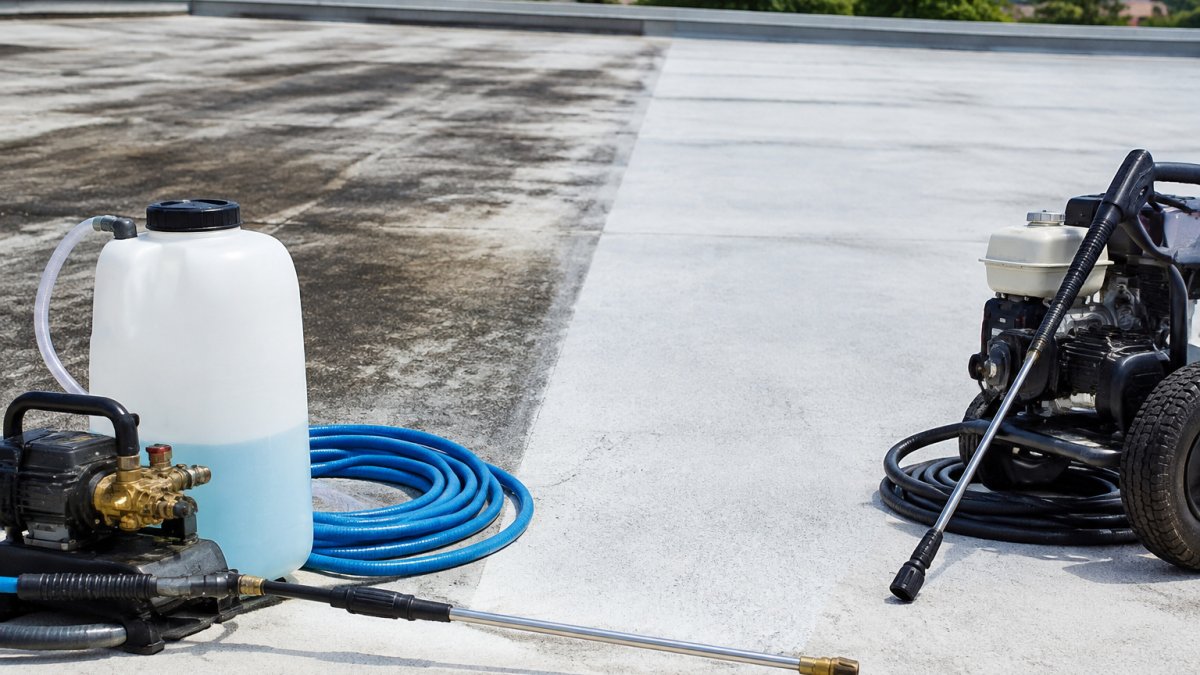
Pressure settings are where the two methods split. Soft Wash Ranger commercial roof cleaning cost guide describes soft washing as using under 100 PSI, compared with 1,200 to 3,500 PSI for pressure washing. Other guides give different ranges, so treat any single number as a reference point rather than a rule.
How Soft Washing Works
Soft washing applies a cleaning solution at low pressure and lets it dwell on the surface (Exterior Wall Washing: Maintaining Commercial Building Facades). Algae, moss, and mildew break down over time, and a gentle rinse removes what is left. Because the force is low, the method is generally less likely to dislodge shingle granules or stress roofing seams.
How Pressure Washing Works
Pressure washing relies on water force to strip material from a surface. It works well on concrete, brick, and storefronts. On a roof, that same force can loosen shingles, expose the asphalt underneath, and push water under flashing. RBM Services comparison of pressure and soft washing for commercial buildings notes that high pressure can damage shingles and may void roof warranties.
Which Method Is Safer for Commercial Roofs
For most commercial roofs, soft washing is the safer choice. The reason is not that pressure washing never works. It is that roofs are fragile in ways that concrete is not. A roof that loses granules or develops a leak costs far more to repair than the cleaning itself.
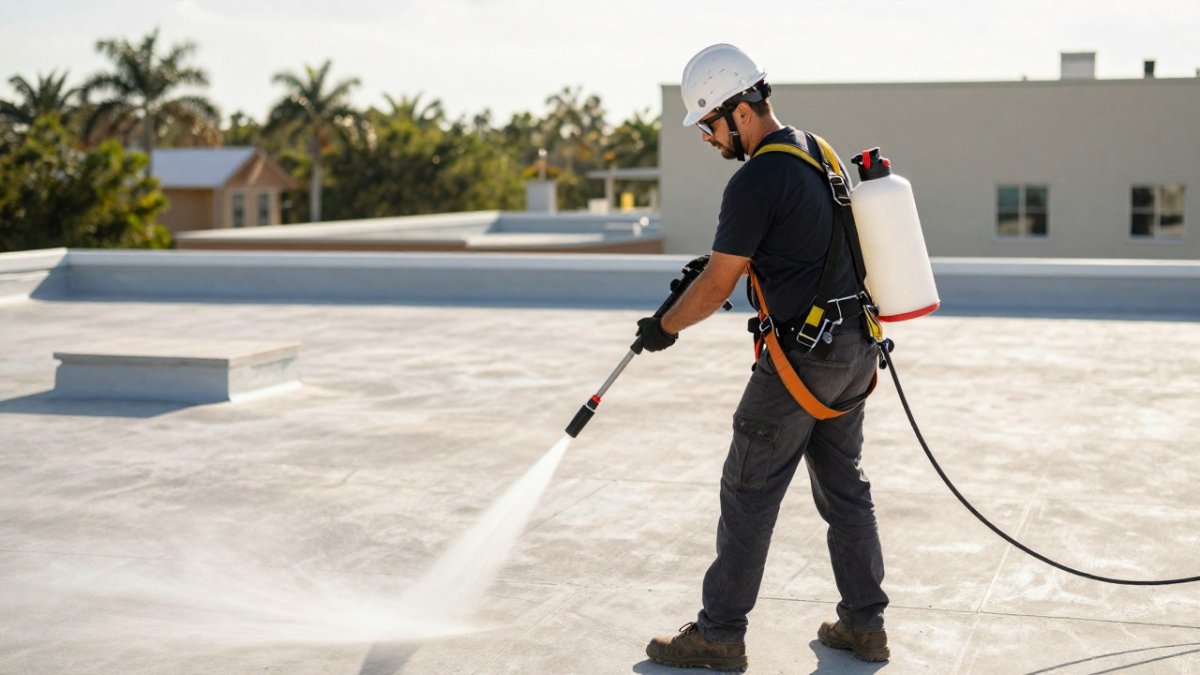
!Technician applying a low-pressure cleaning solution across a flat commercial roof
Roof warranties are another factor. Some manufacturers exclude damage caused by high-pressure cleaning, so a property manager who pressure washes a roof may lose coverage they assumed they had. Check the warranty terms before any cleaning is scheduled.
Commercial Roof Cleaning Methods Compared Side by Side
Method choice on a commercial building is not a single yes-or-no decision. A single-story retail center with a TPO membrane, a metal warehouse, and a built-up roof with gravel surfacing each respond differently to water force and cleaning solution. The table below summarizes the main differences, and the notes after it explain how to apply them by roof system.
| Factor | Soft Wash | High-Pressure Wash |
|---|---|---|
| Typical pressure | Under 100 PSI (per Soft Wash Ranger) | 1,200 to 3,500 PSI (per Soft Wash Ranger) |
| Roof safety | Low risk to membranes, seams, and coatings | Risk of seam separation, granule loss, and leaks |
| Algae and moss | Effective through chemical dwell | Removes surface growth but may leave roots |
| Warranty impact | Usually compatible when manufacturer guidance is followed | Often excluded |
| Best surfaces | Roofs, stucco, siding | Concrete, brick, storefronts |
| Runoff control | Requires containment and dilution planning | Requires containment and volume management |
| Labor profile | Slower application, longer dwell, fewer repairs | Faster pass, higher repair exposure |
Pros of soft washing: generally safer for roofing materials and adaptable to membrane, metal, and coated systems when dilution and dwell are controlled.
Cons of soft washing: slower, depends on chemical dwell time, and requires careful runoff control around landscaping, storm drains, and occupied spaces.
Pros of high-pressure washing: fast on hard surfaces and strong on heavy grime.
Cons of high-pressure washing: risky on roofs, can etch concrete and strip grout, and may void warranties.
Matching the Method to the Roof System
Commercial roofs are not all the same, and the method should follow the manufacturer’s written cleaning requirements rather than a generic rule of thumb.
- Single-ply membrane (TPO, EPDM, PVC): Soft washing at low pressure is the usual approach. High pressure can lift seams, force water under lap joints, and drive dirt into the membrane surface. Check the membrane manufacturer’s cleaning guidance before any solution is applied.
- Metal roofs: Soft washing with a rinse that does not pond at fasteners and seams is preferred. High pressure can strip factory coatings and loosen fasteners, which opens the door to corrosion.
- Built-up and modified bitumen roofs: These surfaces tolerate low-pressure cleaning well, but high pressure can dislodge gravel surfacing and expose the bitumen underneath.
- Coated roofs (acrylic, silicone, polyurethane): Coating manufacturers often specify the cleaning method and the compatible cleaners. High pressure can scar or remove the coating, and that damage is rarely covered.
Operational and Site Considerations
A commercial cleaning is also a site-safety and business-continuity job. Plan for tenant and employee access, work-zone controls, fall protection, and runoff management before the crew arrives. On occupied buildings, schedule around business hours and confirm that roof access does not block HVAC service or emergency egress.
Watch out: runoff from roof cleaning can carry cleaning solution into storm drains, so confirm capture or dilution plans and check any applicable local discharge rules before the job starts.
Total Cost and Lifecycle Value
The lowest bid is not always the lowest cost. Compare labor, equipment, repeat-cleaning needs, repair risk, and potential warranty impacts rather than the initial cleaning price alone. A soft wash that protects a membrane and keeps a warranty intact can cost more up front than a fast pressure pass, but it avoids the repair and replacement exposure that follows damaged seams or stripped coatings. A single crew can often handle more than one surface in the same visit, which can spread the mobilization cost across the property.
The method should be matched to the surface. Freedom Wash Club offers paver sealing, soft wash roof cleanings, house wash and exterior home cleaning, driveway cleaning, and pool deck cleaning, so the scope is clear before scheduling.
Algae, Moss and Mildew Removal on Commercial Roofs
Algae and moss are common roof problems in South Florida’s humid climate. Soft washing with an appropriate cleaning solution is a common approach because it treats the growth rather than just removing the visible stain.
Prevention matters as much as removal. Regular maintenance schedules keep growth from building up to the point where it damages shingles. Freedom Wash Club’s guide on preventing roof moss and algae growth explains what to do after cleaning to slow regrowth.
Building a Commercial Roof Maintenance Checklist
A commercial roof maintenance plan works best when it is tied to a facility maintenance calendar rather than scheduled only after a stain appears. The checklist below is a starting point; adjust frequency to the roof system, the local climate, and the growth rate you observe.
Inspection Frequency and Seasonal Scheduling
- Quarterly visual inspection: Walk the roof or review drone imagery each quarter to catch ponding water, seam separation, fastener back-out, and new organic growth early.
- Pre-season cleaning: Schedule a soft wash before the humid growing season so algae and moss do not establish during the wettest months.
- Post-storm check: Inspect after major wind or hail events for membrane damage, displaced ballast, and clogged drains.
- Annual warranty review: Confirm the current warranty terms and the approved cleaning method with the roof manufacturer or the original installer.
The Maintenance Checklist
- Inspect the roof surface for granule loss, cracks, seam separation, and ponding water.
- Confirm that drains, scuppers, and gutters are clear before each cleaning.
- Soft wash the roof to remove algae, moss, and mildew using the manufacturer-approved method.
- Document the warranty terms and the cleaning method used for each service.
- Photograph the roof before and after each service and file the images with the maintenance record.
- Schedule the next cleaning based on the growth rate you observe and the seasonal calendar.
- Note which surfaces get which method, since pressure washing is typically limited to hardscapes on the same property.
Fitting Cleaning Into a Facility Maintenance Program
Cleaning is one line item in a broader program that includes HVAC service, drain maintenance, and roof repairs. Put roof cleaning on the same calendar as those tasks so access, safety planning, and vendor scheduling are coordinated. Keep a simple log of inspection dates, cleaning dates, methods used, and photos; that log is useful when a warranty question comes up or when a new property manager takes over the building.
Watch out: a cleaning that removes only visible growth may not address the root system, so confirm the plan includes an appropriate soft wash approach rather than a rinse-only pass.
The same maintenance calendar can cover Freedom Wash Club’s paver sealing, soft wash roof cleanings, house wash and exterior home cleaning, driveway cleaning, and pool deck cleaning, which keeps the whole property on one schedule and one vendor relationship.
Questions to Ask a Roof Cleaning Contractor Before You Book
Before hiring anyone, ask specific questions. A reputable company will answer them directly.
- What pressure range do you use on roofs, and do you soft wash by default?
- Which cleaning solutions do you use, and how do you protect plants and runoff?
- Are you licensed and insured for commercial work?
- How will you handle my roof warranty?
- Do you provide before-and-after photos?
Freedom Wash Club is licensed and insured South Florida pressure cleaning company and schedules by phone or text, so you can get answers without an in-person estimate. Compare South Florida pressure cleaning companies for 2026 before you decide.
Booking Your Commercial Roof Cleaning With Freedom Wash Club
For commercial roofs, we recommend soft washing. It is generally gentler on roofing materials and is effective on algae and moss when applied with the right solution and dwell time. Freedom Wash Club also offers paver sealing, soft wash roof cleanings, house wash and exterior home cleaning, driveway cleaning, and pool deck cleaning, so one vendor can cover the whole property. Call or text to schedule, and ask about soft wash roof cleaning for your building.
RECEIVE YOUR FREE QUOTE
Frequently Asked Questions
Is soft washing or high-pressure washing better for commercial roof maintenance?
For most commercial roofs, soft washing is the safer choice. Soft washing uses low pressure, while pressure washing uses much higher pressure. Roofing materials such as asphalt shingles and granules can be damaged by high pressure, and some roofing manufacturers and contractors note that damage can affect roof warranty coverage. Soft washing with an appropriate cleaning solution is a common approach for algae, moss and mildew. High-pressure washing is better suited to surfaces such as concrete and storefronts, so the right method depends on the surface being cleaned.
Can high-pressure washing damage a commercial roof?
Yes. High pressure can dislodge roof granules and affect roof warranties in some cases. The damage may not be visible right away, which is why the cleaning method matters. Sources differ on exact pressure thresholds, so a contractor should explain which pressure they use and why it suits your specific roofing material before work begins.
Does soft washing remove algae and moss from commercial roofs?
Soft washing is commonly used for algae, moss, mildew and other organic growth on roofs. The method applies a cleaning solution that works on the growth over time rather than blasting it off with force. Results depend on the severity of the growth, the roof material and how the solution is applied. Ask the contractor how they treat organic growth and how they protect nearby landscaping and runoff areas.
What should a property manager ask a roof-cleaning contractor?
Ask which cleaning method they use and the pressure range, whether they have experience with your roof system, how they protect roofing materials and warranties, and how they control runoff and protect plants, vehicles and pedestrians. Request proof of licensing and insurance. Freedom Wash Club is licensed and insured, and you can call or text to discuss your roof and request a quote.