Table of Contents
- Why DIY Roof Cleaning Fails to Last
- Soft Wash Roof Cleaning Benefits: Killing Algae at the Root
- How to Remove Black Streaks From Roof Shingles Without Damage
- Material-Specific Roof Cleaning: Asphalt, Tile, Metal, and Shingle
- Warranty and Insurance: How Professional Roof Cleaning Protects Your Coverage
- Professional Exterior Home Cleaning Services: Beyond the Roof
- Maintenance Frequency and Long-Term ROI
- Frequently Asked Questions
Last Updated: September 18, 2026
Why DIY Roof Cleaning Fails to Last
Most homeowners who climb up with a pressure washer and a jug of bleach end up back on the ladder within a year. That is why professional roof cleaning lasts longer: it removes the organism, not just the stain.
The black streaking on your shingles is a living colony of algae. Blast it with high pressure and you strip the discoloration off the granules, but the algae’s root structure stays embedded in the shingle’s limestone filler. Within a few warm, humid months, it blooms right back. Worse, pressure washing drives water under overlapping courses and knocks loose the granules that shield the asphalt from ultraviolet light.
A common mistake is assuming “cleaner equals stronger.” Aggressive methods trade a short-term cosmetic win for premature wear.
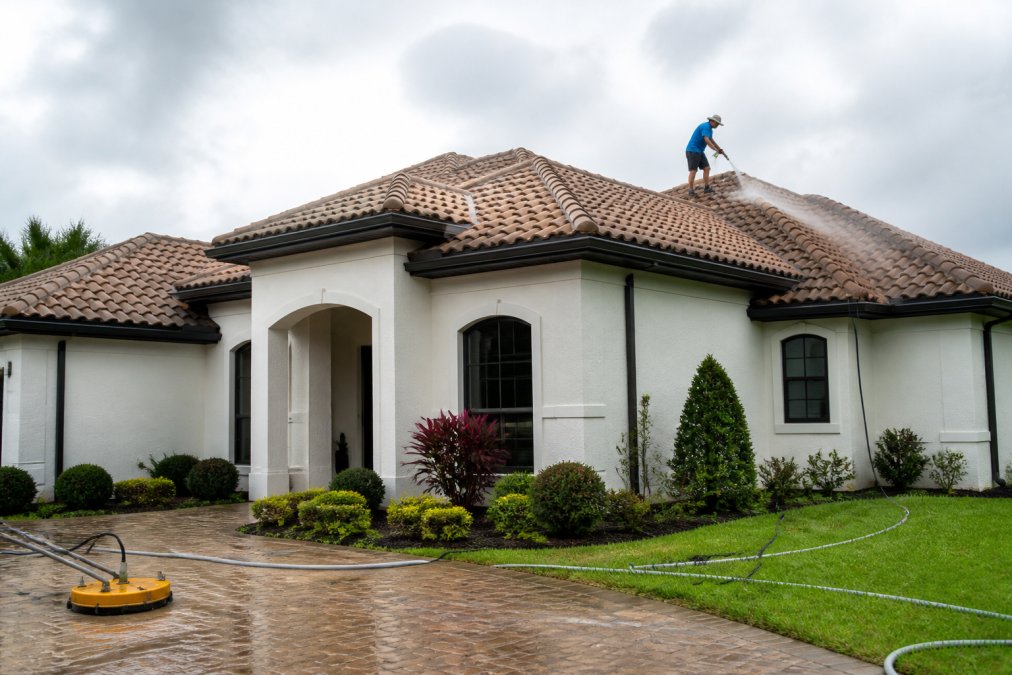
At Freedom Wash Club, we have watched this cycle repeat across South Florida for over a decade. The fix is not more force. It is the right chemistry, applied at the right concentration, with the right rinse.
Pressure washing an asphalt shingle roof can void your roofing warranty and dislodge granules permanently. Once those granules are gone, they do not grow back, and the shingle ages years faster.
Soft Wash Roof Cleaning Benefits: Killing Algae at the Root
Soft wash roof cleaning benefits start with one principle: kill the algae at its source instead of scraping it off the surface. A soft wash applies a low-pressure chemical solution that penetrates the shingle’s porous mat, neutralizes algae and moss at the root, and lets rain rinse the dead growth away over the following weeks.
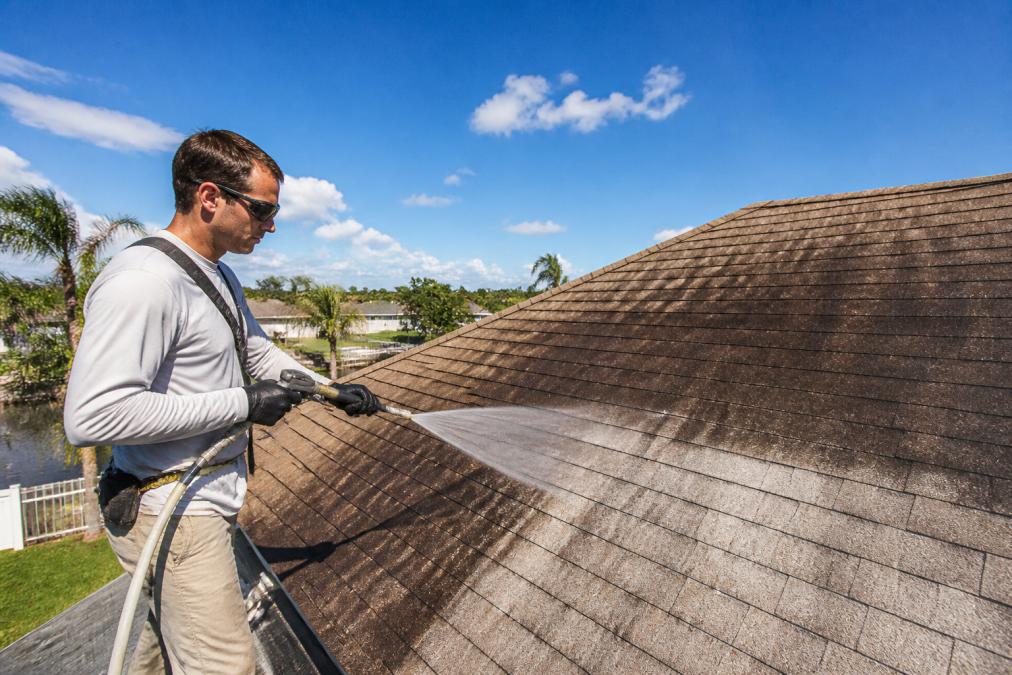
A soft wash system runs at roughly garden-hose force, so water never gets forced beneath the shingles. The cleaning work is done by the solution, not by impact.
That is also why the results hold: because the organism is dead rather than merely displaced, regrowth takes far longer.
Ask any roof cleaning provider what pressure they run on shingles. If the answer is “it depends” without a number, or if they describe blasting at full pressure, walk away. A genuine soft wash never needs high pressure on a roof.
How to Remove Black Streaks From Roof Shingles Without Damage
The safe way to remove black streaks from roof shingles is a soft wash with a diluted sodium hypochlorite solution, applied bottom-up and rinsed thoroughly. Never scrub, pressure wash, or use a stiff brush on asphalt.
Here is the sequence a trained crew follows:
- Pre-wet landscaping and gutters. Plants, siding and downspouts get saturated with plain water first so runoff does not burn them.
- Apply the solution low to high. Working upward prevents streaking and keeps the chemical from running over already-cleaned areas.
- Let it dwell. The solution needs time to break down the algae’s cell structure. Rushing this step is why cheap jobs fail.
- Rinse top to bottom. A gentle rinse carries dead growth off the roof and out of the gutters.
- Protect the runoff. Capture or dilute the wash water before it reaches storm drains and sensitive plantings.
The U.S. Environmental Protection Agency guidance on safer cleaning products is worth reading before any exterior cleaning project, particularly on how runoff affects local waterways.
Steps three and four are where most DIY attempts fall short: homeowners spray, get impatient, and rinse too soon. The stain looks lighter for a month, then returns.
Material-Specific Roof Cleaning: Asphalt, Tile, Metal, and Shingle
No single method fits every roof. Asphalt shingles, clay tile, metal panels and concrete tile each tolerate different chemistry, dwell times and rinse pressures. Getting this wrong causes surface damage, and often voids the manufacturer’s warranty.
| Roof Material | Cleaning Method | Pressure Level | Key Risk to Avoid | Warranty Note |
|---|---|---|---|---|
| Asphalt shingle | Soft wash, diluted sodium hypochlorite | Very low, garden-hose force | Granule loss, warranty void | Most manufacturers require professional cleaning; pressure washing voids coverage |
| Clay or concrete tile | Soft wash, longer dwell, gentle rinse | Low | Cracked tiles from foot traffic | Improper cleaning can void tile warranty; follow manufacturer guidelines |
| Metal | Soft wash, mild solution, no abrasives | Low | Scratching the finish, oxidation | Check warranty for approved cleaning agents; abrasive methods void finish warranty |
| Flat membrane | Soft wash, controlled rinse | Low | Standing water, seam damage | Some warranties require annual professional maintenance; DIY may void |
Asphalt shingles are the most fragile and most common. Their protective granules are the roof’s sunscreen; once they erode, the underlying asphalt oxidizes and dries out. A soft wash with diluted sodium hypochlorite, typically 1% to 2%, kills algae at the root without stripping granules. Most manufacturers specify that pressure washing voids the warranty, so verify the method against your warranty terms.
Tile roofs are tougher against chemicals but brittle underfoot. A soft wash with a longer dwell time penetrates the porous surface without scrubbing. Technicians distribute their weight carefully, often using roof walkway pads or foam boards, and a test patch is standard practice because the solution that works on asphalt may be too aggressive for some tile finishes.
Metal roofs need a gentler mix to avoid dulling the finish. Abrasive brushes or high pressure scratch the protective coating, creating future rust points. A mild soft wash solution at low pressure, rinsed thoroughly, is safest. Check the manufacturer’s warranty for approved cleaning agents, some explicitly require professional cleaning to maintain coverage.
Flat membrane roofs, common on additions and porches, require controlled rinsing to prevent standing water and seam damage.
Before any roof cleaning, check your roofing warranty for specific cleaning requirements. Many manufacturers require professional soft washing and explicitly void coverage if pressure washing or abrasive methods are used. Improper cleaning can also void your homeowner’s insurance if damage results from negligence.
For homeowners with multiple roof types or complex rooflines, a professional exterior cleaning service can assess each surface and apply the correct protocol. Professional exterior home cleaning services go beyond the roof, your siding, driveway and pool deck have material-specific needs too. Paver sealing locks in the clean result on driveways and pool decks, while house washing lifts mold from siding without damaging the finish.
Warranty and Insurance: How Professional Roof Cleaning Protects Your Coverage
Your roofing warranty almost certainly contains language about maintenance and damage from improper cleaning. Manufacturers routinely deny claims where high pressure stripped granules or water intrusion traces back to a pressure-washing job.
The cheapest roof cleaning is the one that voids your warranty. Replacing a roof costs many times more than maintaining it correctly.
Professional Exterior Home Cleaning Services: Beyond the Roof
Professional exterior home cleaning services treat the whole property as one connected system, because that is how dirt, mold and algae behave. The same spores colonizing your shingles work into your siding, driveway and pool deck.
A full exterior package typically covers:
- Soft wash roof cleaning to kill algae and moss at the root
- House washing to lift mold and grime from siding, soffits and eaves
- Driveway cleaning to remove black stains, rust and tire marks from concrete and pavers
- Pool deck cleaning to strip algae and slippery buildup from surrounding surfaces
- Paver sealing to lock in the clean result and slow future staining
Maintenance Frequency and Long-Term ROI
The right cleaning frequency depends on your roof’s shade, tree cover and moisture. In humid climates with heavy afternoon shade, an annual soft wash is the practical baseline. Roofs in full sun with good airflow can often stretch to every 18 to 24 months.
- Estimate your roof’s replacement cost. A typical asphalt shingle roof replacement costs several thousand dollars, depending on size and pitch. Check local contractor quotes.
- Determine your roof’s expected lifespan. Most asphalt shingles are rated for 20 to 30 years, but neglect can cut that by 5 to 10 years.
- Calculate the cost of premature failure. If your roof fails 5 years early, you absorb the replacement cost years sooner than planned.
- Compare against maintenance costs. Professional soft wash roof cleaning typically costs a fraction of replacement. Even annual cleaning over a decade is far less than a new roof.
- Factor in warranty and insurance implications. Improper cleaning can void your warranty, leaving no coverage for defects. Professional maintenance keeps it intact.
| Maintenance Interval | What It Prevents | Best For |
|---|---|---|
| Annual soft wash | Algae regrowth, granule loss | Shaded roofs, humid climates |
| Every 18-24 months | Moss accumulation, staining | Sunny, well-ventilated roofs |
| Recurring full-exterior plan | HOA violations, paver staining | Snowbirds, HOA communities |
Frequently Asked Questions
Why do black streaks return so quickly after improper cleaning?
Improper cleaning often uses high pressure, which strips away the protective granules on asphalt shingles but leaves the algae’s root system intact. The algae regrows faster because the shingle surface is now more porous and holds moisture longer. Professional roof cleaning uses soft washing with specialized cleaning agents that penetrate and kill the algae at the source, so results last two to three times longer than pressure washing alone.
Does professional roof cleaning help prevent moss and algae regrowth?
Yes. Professional roof cleaning removes both the visible algae and its underlying root structure. After treatment, many companies apply a preventative solution that creates an environment where moss and algae struggle to return. Combined with regular maintenance, this approach can keep your roof clean for years rather than months, especially in humid climates like South Florida where algae growth is aggressive.
How does soft washing differ from pressure washing for roofs?
Soft washing uses low water pressure combined with specialized cleaning solutions to kill algae, mold, and mildew at the root. Pressure washing relies on force, which can strip shingle granules, crack tiles, and void warranties. Soft washing is the recommended method for asphalt shingles, tile, and most roofing materials because it cleans thoroughly without causing surface damage or driving water under shingles.
What is the recommended frequency for professional roof maintenance?
Most roofing experts recommend professional roof cleaning every 18 to 24 months in humid climates, or annually if your roof is shaded or prone to heavy algae growth. Scheduling regular maintenance prevents black streaks from becoming deeply embedded and helps you avoid costly repairs. A professional exterior home cleaning service can also bundle roof cleaning with driveway and pool deck cleaning for a complete exterior refresh.