Table of Contents
- Pressure Washing vs Roof Cleaning Services: A Quick Comparison
- Soft Wash Roof Cleaning Benefits: Low Pressure, Big Results
- How to Clean a Driveway Without Damage
- Professional Paver Sealing Services: Protecting Your Investment
- Residential Exterior House Wash Frequency: How Often Is Enough?
- Pressure Washing vs Roof Cleaning Services: Safety, Insurance, and Common Mistakes
- Frequently Asked Questions
Last Updated: September 19, 2026
Pressure Washing vs Roof Cleaning Services: A Quick Comparison
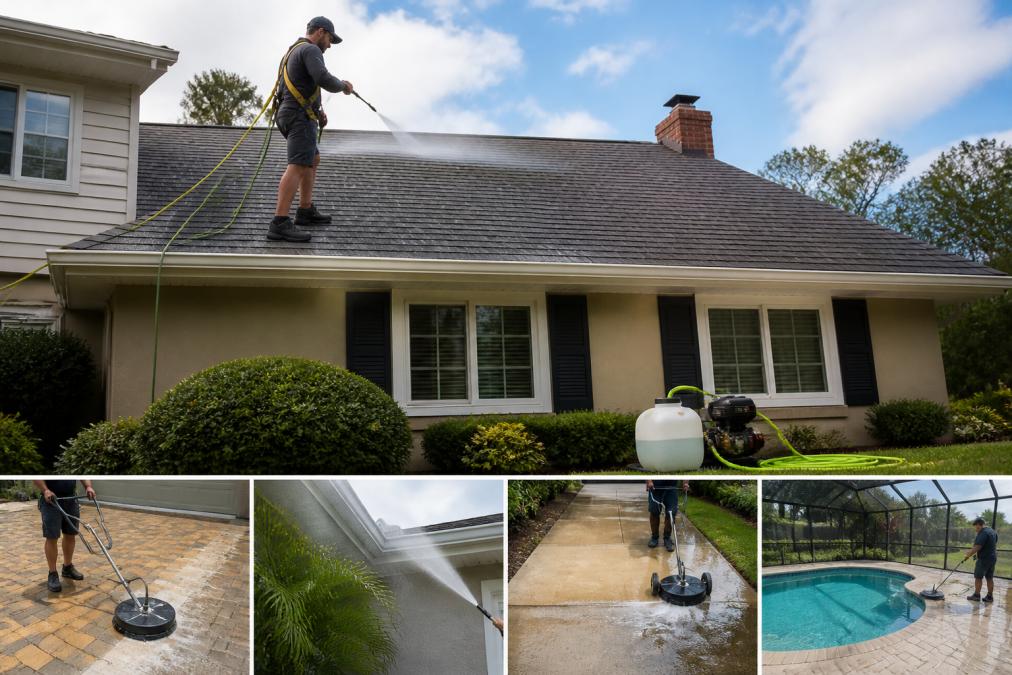
Pressure washing vs roof cleaning services is not a choice between two versions of the same job, it is a choice between two methods, and using the wrong one on the wrong surface leads to repairs instead of maintenance. At Freedom Wash Club, we have spent more than a decade cleaning roofs, driveways, and pool decks across South Florida, and the most common mistake we see is treating every exterior surface the same way.
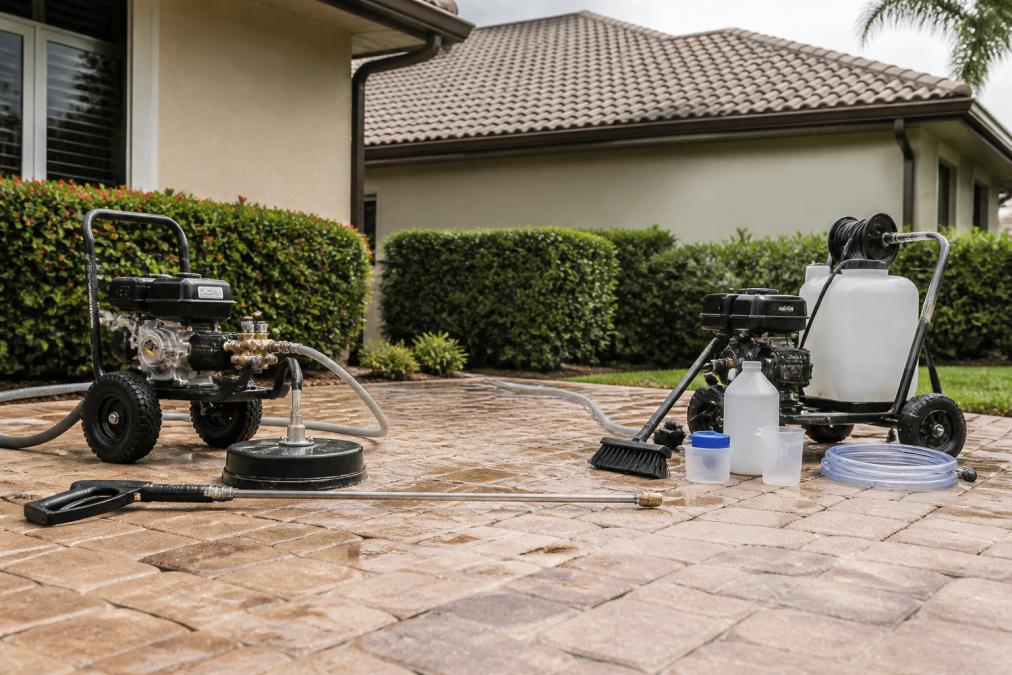
Pressure washing uses high-pressure water, often above 3,000 PSI, to blast dirt off hard, non-porous surfaces. Soft washing is a low-pressure method that relies on cleaning solutions to kill organic growth, then rinses gently.
Here is the short version:
| Surface | Best Method | Why |
|---|---|---|
| Asphalt shingle roof | Soft wash | High pressure strips granules and voids warranties |
| Tile roof | Soft wash | Pressure cracks tiles and destroys sealant |
| Driveway and concrete | Pressure wash | Dense surface handles high PSI without damage |
| Pool deck | Pressure wash | Removes embedded dirt and algae from textured stone |
| Paver driveway | Pressure wash, then seal | Cleaning alone leaves sand joints exposed |
| House siding | Soft wash | Pressure forces water behind siding and into walls |
Soft Wash Roof Cleaning Benefits: Low Pressure, Big Results
- No surface damage to asphalt shingles or tile
- Algae, moss, and lichen removed at the source
- Roof lifespan extended rather than shortened
- Manufacturer warranty protection preserved
- Results typically last far longer than pressure washing
High-pressure cleaning on an asphalt shingle roof can void your manufacturer’s warranty. Many shingle warranties explicitly exclude damage from pressure washing, which means a failed roof becomes your expense, not the manufacturer’s.
A common mistake is assuming a steeper roof needs more pressure. The opposite is true: steep roofs need more dwell time for the cleaning solution, not more PSI.
How to Clean a Driveway Without Damage
Cleaning a driveway without damage comes down to matching pressure and technique to the surface. Concrete and asphalt handle pressure washing well, but the wrong nozzle, too much pressure, or a careless pass can etch concrete or strip asphalt.
Follow this sequence:
- Clear the driveway of vehicles, toys, and debris
- Pre-treat oil stains and rust spots with a dedicated degreaser
- Apply a cleaning solution and let it dwell for several minutes
- Use a surface cleaner attachment for even coverage, not a narrow wand tip
- Keep the wand moving in overlapping passes, never holding still
- Rinse with clean water and let the surface dry fully
- Inspect for remaining stains and spot-treat before resealing
Professional Paver Sealing Services: Protecting Your Investment
Professional paver sealing services protect the investment you already made in your driveway, pool deck, or patio. Pavers are porous: without a sealer, sand works out of the joints, weeds take hold, and color fades faster than it should. Cleaning without sealing is a half-finished job.
- Joint sand is replenished after cleaning to lock pavers in place
- Sealer blocks water, oil, and UV damage from reaching the surface
- Color enhancement options bring back a faded finish
- Weed and insect pressure drops sharply once joints are sealed
- Resealing every few years keeps the surface easy to clean
Why Joint Sand Fails in the First Place
Joint sand does not disappear because of rain alone. Water infiltrates the joint, sand particles suspend, and traffic or thermal expansion pumps them out. Once the joint is empty, pavers lose their interlock and shift independently, causing lippage, rocking, and weeds. Re-sanding without sealing repeats the cycle, because the new sand has nothing holding it in place.
Film-Forming vs. Penetrating Sealers
Most practitioners divide paver sealers into two families, and the choice changes how the surface behaves for years.
| Sealer Type | How It Works | Best For | Trade-Off |
|---|---|---|---|
| Film-forming (acrylic, urethane) | Cures into a thin protective layer on top of the paver | Color enhancement, high-traffic driveways, pool decks | Can peel or haze if applied too thick or over damp pavers |
| Penetrating (siloxane, silane) | Soaks into the paver and repels water from within | Natural look, freeze-thaw climates, older pavers | Little to no color enhancement, requires reapplication sooner |
The Re-Sand Step Most Crews Skip
After cleaning, the joints are typically half-empty. A proper re-sand uses polymeric sand, which activates when misted and forms a flexible bond that resists washout far better than plain silica sand. Sweep the sand into the joints, compact it, mist it in two passes, then let it cure before any sealer touches the surface. Sealing over damp polymeric sand traps moisture and causes the haze homeowners blame on the sealer.
Test your sealer’s condition with a simple water drop. If water soaks in within a minute, the sealer has worn through and it is time to reseal. If it beads and sits, you still have protection.
How Often to Reseal
A common pattern is every two to three years for film-forming sealers on a sun-exposed driveway, and every one to two years for penetrating sealers on a pool deck with heavy chemical exposure. Pool decks age faster because chlorine, salt, and constant moisture break down the sealer film, while a shaded driveway may go longer because UV is the primary degradation driver.
Residential Exterior House Wash Frequency: How Often Is Enough?
Most homes need an exterior house wash once a year, with homes in humid climates often needing it twice. That surprises people who assume cleaning is a once-every-five-years event.
| Home Situation | Recommended Frequency |
|---|---|
| Shaded lot with heavy tree cover | Every 6 months |
| Standard suburban lot | Once a year |
| Newer construction, low shade | Every 12-18 months |
| Home preparing to sell | Before listing, regardless of schedule |
| HOA-regulated community | Per HOA standards, often annually |
Pressure Washing vs Roof Cleaning Services: Safety, Insurance, and Common Mistakes
Safety and insurance are where the difference between a professional and a bargain crew becomes obvious. Roof work is the highest-risk exterior cleaning job there is. Wet shingles, steep pitches, and ladders on uneven ground cause a large share of home maintenance injuries every year, and the Occupational Safety and Health Administration guidance on fall protection treats residential roof work as a serious hazard category for good reason.
The most common mistakes we see homeowners make:
- Pressure washing a shingle roof because it looks faster
- Hiring on price alone without verifying insurance
- Skipping the cleaning solution and relying on water pressure only
- Letting a crew work on a steep roof without fall protection
- Cleaning pavers without resealing, then wondering why weeds return
If a contractor cannot provide a certificate of insurance on request, do not let them on your roof. An uninsured injury on your property can become your liability, and the savings from a cheaper quote disappear fast.
The DIY Risk Assessment Nobody Publishes
Most service pages tell you to hire a pro. Very few explain what actually goes wrong when a homeowner tries it themselves. Here is the honest breakdown by surface.
- Warranty void. Most asphalt shingle manufacturers explicitly exclude damage from pressure washing. A homeowner who pressure washes their own roof can lose warranty coverage on a roof that still has years of expected life.
- Granule loss. Shingle granules are the UV and rain barrier. High pressure strips them, and they do not grow back. The roof ages years in a single afternoon.
- Slip hazard. Wet shingles, especially those already colonized by algae, are slicker than they look. A fall from a single-story roof is still a serious injury.
- Root survival. Pressure washing removes the visible stain but leaves the gloeocapsa magma root structure in the shingle. The streaks return within a season, so the DIY effort produces a shorter-lasting result than a soft wash.
- Chemical runoff. Cleaning solutions applied without controlled runoff can kill landscaping below and run into storm drains. A professional crew rinses plants before and after and manages the runoff path.
What to Ask Before You Hire Anyone
A short script saves a lot of trouble. Ask for the certificate of insurance, ask whether they soft wash roofs or pressure wash them, ask what cleaning solution they use, and ask whether they re-sand and seal pavers or just clean them. A crew that cannot answer those four questions clearly is not the crew for a roof or paver driveway.
Frequently Asked Questions
Can you pressure wash a roof?
You should not pressure wash a roof. High-pressure water can strip the protective granules from asphalt shingles, crack tiles, and force water under flashing. Instead, use soft washing, which applies low-pressure water with biodegradable cleaning solutions to kill algae, moss, and lichen at the root. This method protects shingle integrity and keeps your roof under warranty.
What is the difference between soft washing and pressure washing?
Soft washing uses low pressure, usually under 500 PSI, combined with chemical detergents to break down organic growth. Pressure washing uses high pressure, often 2,000 PSI or more, to blast away dirt and grime from hard surfaces like concrete. For roofs, soft washing is the safe choice; pressure washing is better for driveways, pool decks, and pavers.
How often should you have your roof professionally cleaned?
Most roofs need professional cleaning every 2 to 3 years. In humid climates with heavy shade, annual soft washing may be necessary to prevent algae and moss from returning. Regular preventative maintenance extends roof lifespan and preserves curb appeal. If you notice black streaks or green patches, schedule a soft wash roof cleaning before the growth spreads.
Is pressure washing safe for asphalt shingles?
No. Pressure washing asphalt shingles can remove the ceramic granules that protect the asphalt layer, leading to premature aging and leaks. The shingle manufacturer may void your warranty if high-pressure cleaning is used. Always choose soft washing for shingle roofs, and hire a licensed and insured professional who follows safety protocols.
What are the benefits of professional exterior home cleaning?
Professional exterior house washing removes mold, mildew, and dirt from siding, driveways, and roofs, restoring curb appeal and protecting property value. It also prevents costly repairs by stopping organic growth from eating into surfaces. For HOA compliance and real estate prep, regular cleaning keeps your home looking its best and avoids fines.