Quick Summary
The manufacturer-approved roof cleaning methods for asphalt shingles use a diluted household bleach solution applied at low pressure and rinsed thoroughly, as recommended by ARMA guidance. Always confirm the method against your specific shingle manufacturer’s maintenance document, since its written instructions control and can change what voids your warranty.
- Dark streaks on asphalt shingles are typically caused by blue-green algae.
- ARMA recommends a diluted household bleach and water solution applied at low pressure.
- High-pressure washing can knock granules loose and shorten the roof’s life.
- Your shingle manufacturer’s maintenance document controls, not a retailer’s summary or contractor blog.
- Mix weaker and apply a second pass rather than using a stronger solution on stubborn stains.
Table of Contents
- Why Algae and Dark Streaks Form on Asphalt Shingles
- What ARMA Roof Cleaning Guidelines Say About Shingle Care
- Why Pressure Washing Shingles Risks Damage and Warranty Problems
- Manufacturer-Approved Solutions, Dilution Ratios, and Application Steps
- How to Remove Moss From Roof Without Damaging Shingles
- Choosing the Best Roof Algae Remover and the Best Time of Year to Clean
- Scheduling a Professional Roof Cleaning Inspection With Freedom Wash Club
- Frequently Asked Questions
How to Clean Roof Shingles With Manufacturer-Approved Methods
Last Updated: November 26, 2026
Why Algae and Dark Streaks Form on Asphalt Shingles
Dark streaks on roofs most often come from one source: algae. Knowing the right roof cleaning methods starts with understanding that a warm, humid climate gives algae everything it needs to grow.
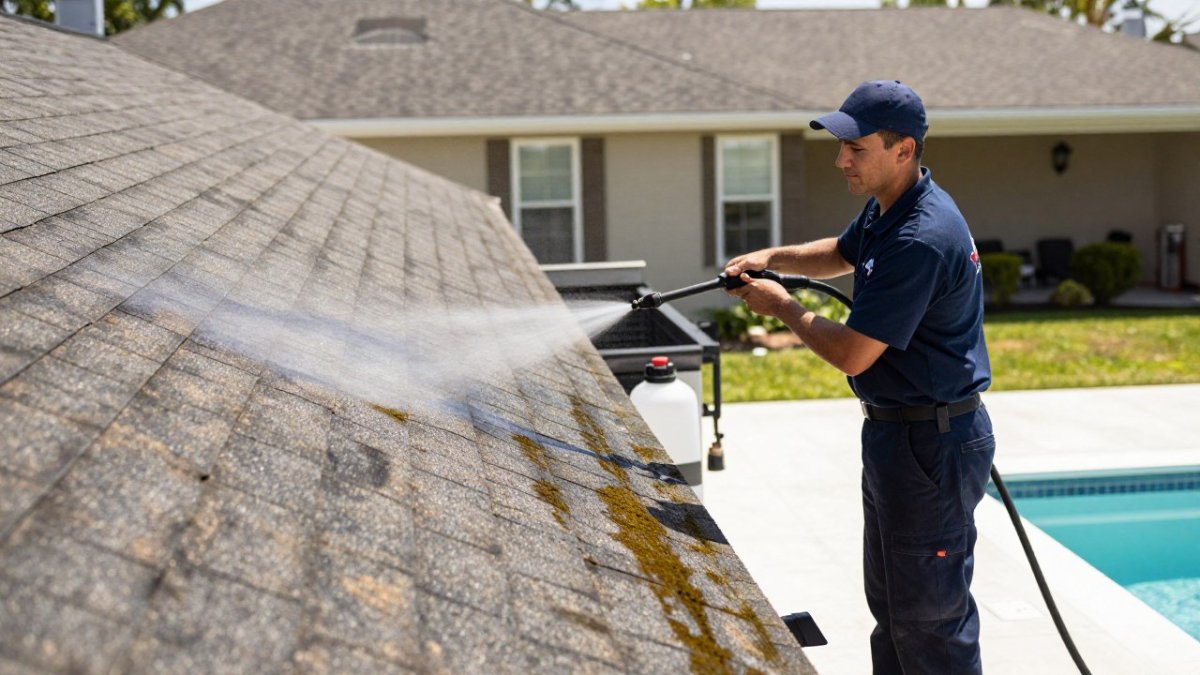
Black streaks on asphalt shingles are typically caused by blue-green algae, which leave dark bands down the roof surface. These stains are cosmetic at first, but they can hold moisture against the shingle and speed up wear over time.
Knowing the cause matters because it shapes the cleaning method. Pressure alone won’t kill the growth, and scrubbing can strip the protective granules. Good roof cleaning methods remove the algae without harming the shingle.
What ARMA Roof Cleaning Guidelines Say About Shingle Care
The Asphalt Roofing Manufacturers Association is the industry group most homeowners should know about, but the value of citing ARMA is in the specifics, not the name. According to ARMA guidance on algae discoloration of roofs, the recommended approach for lightening algae stains on asphalt shingles is a diluted solution of household bleach (sodium hypochlorite) and water, applied at low pressure and rinsed thoroughly. ARMA frames this as the conservative baseline, not a universal recipe, and explicitly states that other chemicals or cleaning methods should not be used without the shingle manufacturer’s approval.
That distinction matters because ARMA is an industry association, not a warranty issuer. To see how roof cleaning affects your coverage specifically, read whether roof cleaning voids shingle warranty. ARMA’s guidance describes what the industry considers safe for asphalt shingles in general. Your warranty is a contract with a specific manufacturer, and that manufacturer’s written instructions control. A method that follows ARMA to the letter can still void a warranty if the shingle maker’s own maintenance document says something different.
How to verify current guidance before you clean:
- Find your shingle brand and product line. Check the wrapper on a spare bundle, the inside of an attic access panel, or the original contractor’s paperwork. Brand alone is not enough, product lines within the same brand can carry different care instructions.
- Pull the manufacturer’s current maintenance document. Look for a document titled something like “Roof Maintenance,” “Cleaning and Maintenance,” or “Care and Cleaning” on the manufacturer’s own site. Do not rely on a retailer’s summary or a contractor’s blog.
- Check the warranty document separately. The warranty and the maintenance guide are different documents. The warranty tells you what voids coverage; the maintenance guide tells you what the manufacturer considers acceptable cleaning.
- Note the revision date. Manufacturer documents get updated. If the version you are reading is more than a few years old, look for a newer one before you act.
- When in doubt, call the manufacturer’s technical line. Most major shingle makers staff a technical services number, and a short call is the cheapest way to confirm a method in writing.
A common pattern is that homeowners assume one brand’s guidance applies to another. It does not. Treat every manufacturer’s document as the controlling authority for that manufacturer’s shingles, and treat ARMA’s guidance as the fallback when no manufacturer document is available.
Watch out: a contractor who quotes “industry standard” without naming the specific manufacturer document is giving you a general practice, not a warranty-safe method. Ask for the document name and revision date before you approve the work.
Why Pressure Washing Shingles Risks Damage and Warranty Problems
High-pressure washing is the method most likely to cause harm. Many roofing manufacturers and cleaning professionals advise against it, and CertainTeed’s roof maintenance guidance specifically warns against using a power washer on its shingles.
The damage is often hidden. Strong water pressure knocks loose granules off the surface, exposing the asphalt underneath. Over time, that can shorten the roof’s life.
For most shingle roofs, low-pressure soft washing is the approach to choose. You can read more about whether soft washing is safe for asphalt shingles before you decide.
Manufacturer-Approved Solutions, Dilution Ratios, and Application Steps
Start with the approved cleaner, then mix it carefully. Follow your shingle manufacturer’s dilution guidance first. If you have no guidance, use the general approach ARMA describes and keep the mix weak. The hard part is that “weak” is not a number, and the bleach you buy at the store is not the same concentration as the bleach a contractor buys. Here is how to turn a ratio into an actual mix.
Step 1: Read the concentration on the bottle. Household bleach is typically sold at a lower concentration than pool-grade sodium hypochlorite, and the two are not interchangeable at the same ratio. The label states the active ingredient percentage. Write it down before you do any math.
Step 2: Convert the ratio to parts. A 1:10 ratio means one part cleaner to ten parts water, for eleven total parts. A 1:4 ratio means one part cleaner to four parts water, for five total parts. Decide how much total solution you need, then divide by the total parts to get the size of one part.
Step 3: Do the math for your batch size. If you need four gallons of solution at 1:10, one part is four divided by eleven, or roughly 0.36 gallons of cleaner, plus the rest water. If you need four gallons at 1:4, one part is four divided by five, or 0.8 gallons of cleaner. Always add cleaner to water, never water to concentrated cleaner, and mix in a ventilated area. For a broader comparison of commercial pressure washing methods and equipment, see that overview.
Step 4: Adjust for concentration, not for stubbornness. If your bottle is a higher concentration than the ratio assumes, dilute it further rather than applying it stronger. Stronger is not more effective on algae, it is more likely to dry on the shingle, stain the surface, or damage plants. When in doubt, mix weaker and apply a second pass after the first has been rinsed.
Application parameters that matter:
- Dwell time. Let the solution sit long enough to kill the growth, but never let it dry on the shingle. On a hot, sunny day that window can be minutes, not hours. Work in sections you can apply and rinse before the surface dries.
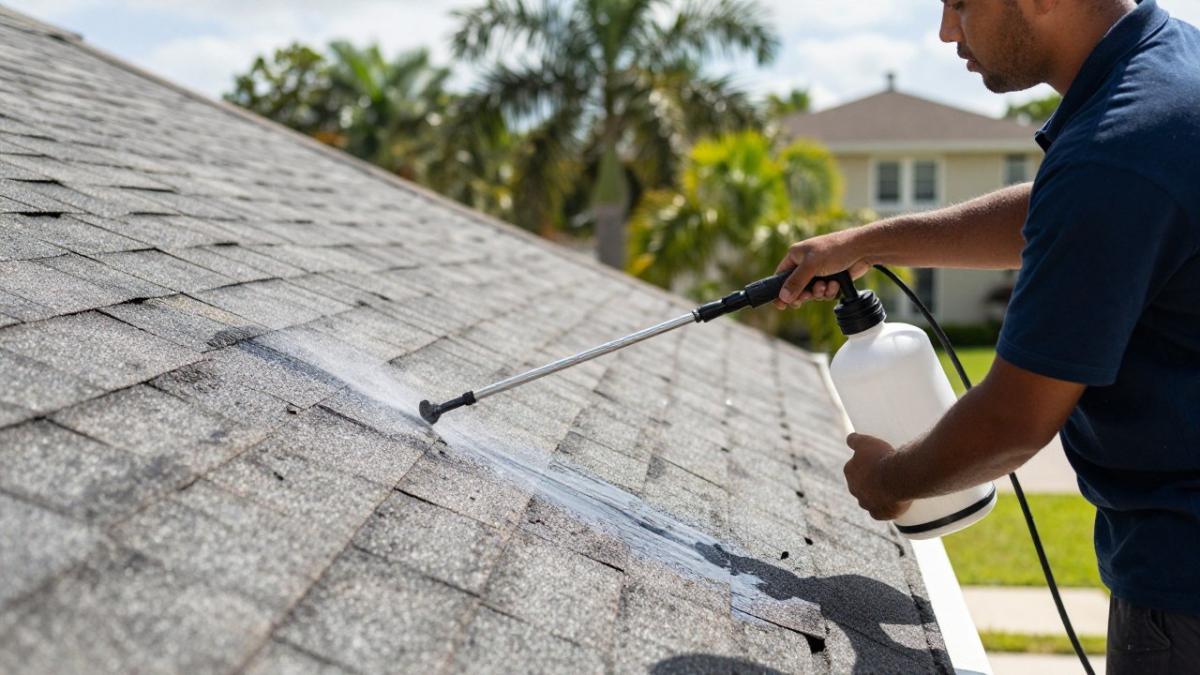
- Application direction. Work from the bottom of the roof upward so the cleaner does not run down over dry shingles below and leave streaks.
- Rinse volume. Rinse with low-pressure water until the runoff runs clear. Rinse the plants and ground below as thoroughly as the roof itself.
- Runoff management. Keep runoff away from storm drains, and pre-wet landscaping before you start so plants absorb clean water first. A pool-grade sanitizer or sodium hypochlorite solution can damage plants if it runs off unchecked.
A simple process:
- Check the forecast. Pick a cool, overcast day. Hot sun dries the solution too fast and can leave streaks.
- Wet the surrounding plants. Soak shrubs and grass with plain water before you start.
- Mix the solution. Use the concentration math above, not a guess.
- Apply with a pump sprayer. Work from the bottom of the roof upward, using low pressure.
- Let it sit. Give the cleaner time to work, but do not let it dry on the surface.
- Rinse gently. Use low-pressure water to rinse the shingles and the ground below.
Watch out: mixing a stronger batch to speed up a stubborn stain is the most common way homeowners damage shingles and landscaping. If a stain does not lift after a normal pass, the answer is a second application, not a stronger mix.
When the roof is part of a larger exterior refresh, the same low-pressure approach carries over to soft wash roof cleanings, house wash and exterior home cleaning, driveway cleaning, pool deck cleaning, and paver sealing, each surface has its own dilution and rinse requirements, so do not carry one mix across all of them.
Dilution and rinse needs differ by surface, so each service calls for its own approach.
| Surface | Approach | Key note |
|---|---|---|
| Roof shingles | Low-pressure soft wash | Follow the manufacturer’s dilution guidance |
| Exterior walls (house wash) | Low-pressure cleaning | Same low-pressure approach carries over |
| Driveway | Cleaner suited to the surface | Do not carry one mix across surfaces |
| Pool deck | Cleaner suited to the surface | Rinse plants and ground thoroughly |
| Pavers | Sealing after cleaning | Each surface has its own requirements |
How to Remove Moss From Roof Without Damaging Shingles
Moss needs a gentler touch than algae. Do not scrape or pull it off with force, because that can tear the shingle surface.
A common mistake is using a stiff brush. Use a soft brush and a mild, approved cleaner instead. Let the solution loosen the moss, then rinse it away with low water pressure.
Remove leaves and debris from valleys and gutters before you start, since trapped moisture under debris can keep moss alive. For ongoing care beyond moss, see this guide to maintaining roof shingles for beginners.
Choosing the Best Roof Algae Remover and the Best Time of Year to Clean
The best roof algae remover is one that your shingle manufacturer approves. Look for a product labeled for asphalt shingles and read the directions before you buy. Avoid any product that promises fast results with strong pressure or harsh scrubbing.
Timing matters too. In South Florida, the cooler, drier months are usually easier for cleaning, because the solution stays wet long enough to work and the roof dries evenly afterward.
Regular maintenance keeps the job small. Cleaning once a year is far easier than waiting for stains to set in.
Scheduling a Professional Roof Cleaning Inspection With Freedom Wash Club
Some roofs are better left to a professional. Steep pitches, heavy staining, and uncertainty about your shingle warranty all call for expert help. If you are unsure which approach fits your roof, the team at Freedom Wash Club can look at your situation and recommend a safe method.
You can book a roof cleaning inspection and learn which services suit your home. Scheduling is simple by phone or text, and we are licensed and insured.
Frequently Asked Questions
What is the best cleaning solution for roof shingles?
Most shingle manufacturers and the Asphalt Roofing Manufacturers Association point to diluted sodium hypochlorite solutions, often described as household bleach mixed with water, for lightening algae stains. The ARMA guidance warns against using other chemicals or methods without the shingle manufacturer’s approval, so check your shingle maker’s instructions before choosing a product. Because approved ratios vary, confirm the exact mix for your roof, and consider a professional who knows the warranty requirements for your specific shingle line.
Can pressure washing damage asphalt shingles?
Yes. CertainTeed advises against using a power washer on its shingles, and industry guides note that high-pressure washing can strip granules, loosen shingles, and affect warranty coverage. Low-pressure soft washing with an approved solution is the method most often recommended for asphalt shingles. Anyone considering pressure cleaning should first review the manufacturer’s warranty terms.
How do you remove moss from a roof without damaging shingles?
Remove moss gently by hand or with a soft brush rather than scraping or using abrasive tools, which can loosen granules. Apply an approved cleaning solution at low pressure, allow it to dwell as the product directs, and rinse gently with water. Avoid walking on wet shingles, and keep runoff away from plants and landscaping during the process.
Why should I schedule a professional roof cleaning inspection instead of doing it myself?
A professional can assess your roof condition, confirm which cleaning approach fits your shingle type, and apply solutions at safe dilutions with low-pressure equipment. Freedom Wash Club, a locally owned and operated South Florida company, is licensed and insured and offers easy scheduling by phone or text. Visit the Freedom Wash Club website or call to request a free quote, since pricing depends on roof size, condition, and access.