Table of Contents
- Roof Cleaning Cost vs Replacement Value: What the Numbers Show
- How Cleaning Preserves Roof Structural Integrity and Lifespan
- Soft Wash Roof Cleaning Benefits That Protect Your Investment
- How to Remove Black Streaks from Roof Shingles Without Damaging Them
- Professional Exterior Home Cleaning Services: Beyond the Roof
- When Cleaning Is No Longer Enough: Signs Replacement Is Unavoidable
- Insurance, ACV vs RCV, and the Real Cost of Deferred Maintenance
- Actual Cash Value vs Replacement Cost Coverage: What Homeowners Need to Know
- How a Claim Actually Pays Out: Depreciation, Deductibles, and Recoverable Depreciation
- Why Your Insurance Premium and Renewal Rewards Upkeep
- Regional Pricing Variations and What They Mean for Your Claim
- Where Maintenance Fits in the Insurance Picture
- Making the Decision: A Cost-Benefit Framework for Homeowners
- Frequently Asked Questions
Last Updated: September 22, 2026
Roof Cleaning Cost vs Replacement Value: What the Numbers Show
The roof cleaning cost vs replacement value comparison comes down to one question: spend a little now on maintenance, or a lot later on a new roof. Freedom Wash Club has spent over a decade helping South Florida homeowners answer it, and the math rarely favors waiting.
Why South Florida Roofs Face Unique Pressure
Heat, humidity, and year-round sun make this region brutal on roofing materials. Algae and mold grow faster here, and black streaks on asphalt shingles are usually algae feeding on limestone filler. Left alone, that growth holds moisture against the roof deck and speeds up shingle degradation.
The Financial Stakes: Capital Expenditure vs Preventative Maintenance
A replacement roof is a capital expenditure; cleaning is preventative maintenance. Deferred maintenance shortens roof lifespan and pushes that capital expenditure forward by years, so the smarter play is a maintenance schedule that keeps the roof out of the replacement column.
How Cleaning Preserves Roof Structural Integrity and Lifespan
Roof structural integrity depends on the deck, underlayment, and shingles staying dry. Cleaning is not cosmetic, it removes the organic growth that traps moisture and breaks down shingles.
Shingle Degradation and the Cost of Waiting
Granules protect asphalt shingles from UV rays. Once algae and moss take hold, they lift granules and expose the asphalt underneath, that is when leaks start. Waiting for a visible leak is a mistake, because by then the underlayment is often already compromised.
Algae and Moss Removal: Stopping the Spread Before It Reaches Underlayment
Algae spreads in streaks and moss grows in shaded, moisture-heavy areas; both hold water against the surface. Professional algae and moss removal stops that spread before it reaches the underlayment.
Soft Wash Roof Cleaning Benefits That Protect Your Investment
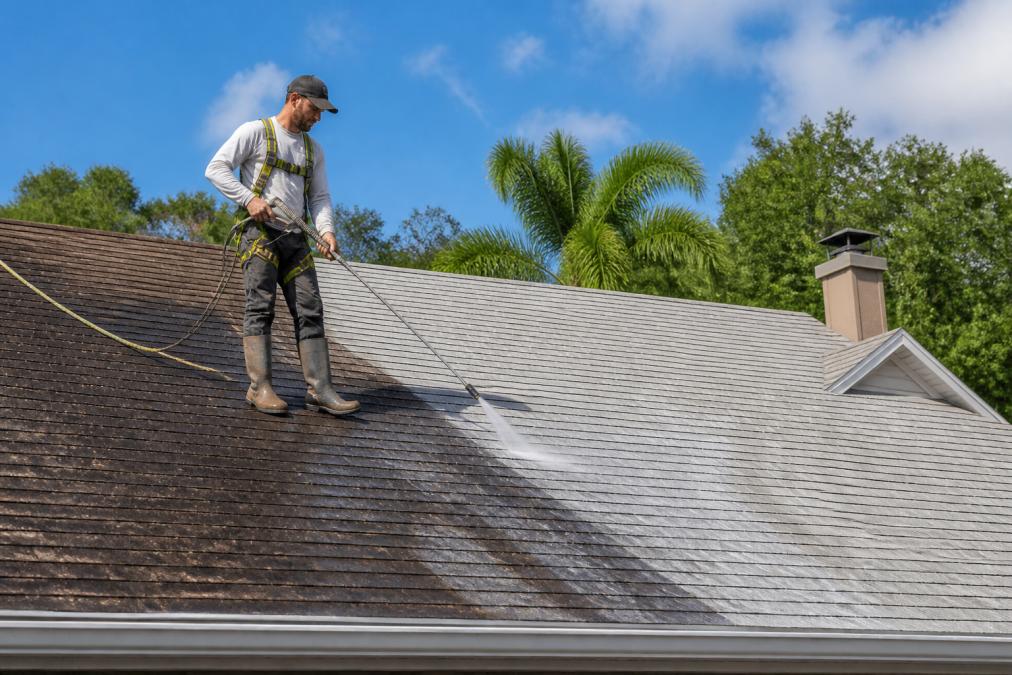
The biggest soft wash roof cleaning benefit is that it cleans without the damage pressure washing causes, using low pressure and specialized solutions to kill organic growth at the root.
Low Pressure, High Return: Why Soft Wash Beats Pressure Washing on Shingles
Pressure washing blasts granules off shingles and can void manufacturer warranties. Soft wash lets the cleaning solution do the work, leaving a roof that looks new without the surface damage that shortens its life.
Pressure washing an asphalt shingle roof can strip the protective granules and void your warranty. If a contractor reaches for a high-pressure wand on your shingles, stop the job.
How to Remove Black Streaks from Roof Shingles Without Damaging Them
The safe way to remove black streaks from roof shingles is a soft wash treatment that kills the algae rather than scrubbing it away. Scrubbing and high pressure both damage the shingle surface.
DIY vs Professional Risk Assessment
Store-bought sprays handle small spots but rarely kill algae at the root, so streaks return, and DIY means ladder work on a steep, wet roof. A professional assessment weighs roof pitch, material, and growth severity before recommending a method.
| Factor | DIY Approach | Professional Soft Wash |
|---|---|---|
| Safety risk | High on steep, wet roofs | Managed by trained crew |
| Root cause removal | Often surface only | Kills algae at the source |
| Warranty risk | High with pressure washing | Low with soft wash method |
| Regrowth timeline | Often returns quickly | Treated to slow regrowth |
| Best for | Tiny, accessible spots | Full roofs and heavy growth |
If your roof is steep or shows heavy growth, the cost of a professional soft wash is almost always less than the cost of repairing damage from a DIY fall or a botched pressure wash.
Professional Exterior Home Cleaning Services: Beyond the Roof
Professional exterior home cleaning services treat the whole property, not just the roof. Algae, mold, and grime spread from the roof to the siding, driveway, and pool deck.
Driveway Cleaning and Pool Deck Cleaning: Protecting Hardscape Value
Driveway cleaning and pool deck cleaning protect hardscape surfaces from the same organic growth that attacks roofs. Concrete and pavers stain, and slippery pool decks are a real safety issue.
Paver Sealing and House Wash: The Curb Appeal Multiplier
Paver sealing locks out moisture and stops weeds and stains from taking hold in the joints. A house wash removes the mold and mildew that build up on siding and trim. Together with roof cleaning, these services deliver the curb appeal that drives appraisal value and keeps HOAs satisfied.
When Cleaning Is No Longer Enough: Signs Replacement Is Unavoidable
Replacement becomes unavoidable when the roof has lost the structure to hold up under cleaning. Age, widespread granule loss, and soft spots in the deck are the usual tipping points.
Roof Condition Assessment: What a Professional Looks For
A roof condition assessment checks granule loss, cracked or curling shingles, flashing, and the underlayment, plus sagging that signals structural damage. These findings decide whether cleaning will help or is money spent on a failing roof.
The 25% Rule and Other Industry Benchmarks
A widely used benchmark holds that if roughly a quarter of the roof shows damage, replacement usually makes more sense than repair. Other signals include a roof past its expected lifespan and repeated leaks in different spots; when several stack up, cleaning stops being a cost-benefit win.
Insurance, ACV vs RCV, and the Real Cost of Deferred Maintenance
Insurance payouts hinge on your policy type, which changes the math on maintenance.
Actual Cash Value vs Replacement Cost Coverage: What Homeowners Need to Know
Actual Cash Value (ACV) pays the depreciated value of your roof: the insurer takes replacement cost, subtracts depreciation based on age and condition, and pays the remainder. Replacement Cost Value (RCV) covers replacement at today’s prices, up to policy limits, with depreciation typically recoverable after the work is completed and invoiced.
How a Claim Actually Pays Out: Depreciation, Deductibles, and Recoverable Depreciation
The claim mechanics matter as much as the policy label:
- Adjuster inspection. The insurer sends an adjuster to document the damage and estimate replacement cost.
- Depreciation withheld. On an ACV policy, depreciation is subtracted immediately. On an RCV policy, it is typically withheld until the work is done.
- Deductible applied. Your deductible comes off the top either way.
- Recoverable depreciation released. On RCV policies, once you submit the final invoice showing the work was completed, the withheld depreciation is released.
Why Your Insurance Premium and Renewal Rewards Upkeep
Insurers increasingly send roof condition assessments before renewing a policy. Untreated algae, moss, or granule loss raises flags, and some carriers will non-renew rather than take on the risk. A well-maintained roof holds more appraisal value and gives you more room to negotiate at claim time.
Regional Pricing Variations and What They Mean for Your Claim
Roof replacement pricing swings widely by region, driven by labor rates, material availability, code requirements, and storm-season demand. A homeowner in a high-cost metro can face a bill several times what a rural homeowner pays for the same square footage. That matters for two reasons:
- Policy limits. A coverage cap set years ago may no longer reflect current regional pricing, many homeowners discover this only at claim time.
- The cleaning-vs-replacement math. In high-cost regions, extending roof life through soft wash roof cleaning and preventative maintenance is even more valuable, because the replacement you defer costs more.
ACV vs RCV is not just a policy label, it is a claim mechanic. On an ACV policy, every year of deferred maintenance widens the depreciation gap you cover out of pocket. On an RCV policy, a maintained, documented roof makes recoverable depreciation easier to collect.
Where Maintenance Fits in the Insurance Picture
Insurance does not pay for maintenance, it pays for sudden, covered damage. That is why maintenance matters: it keeps the roof in the condition that makes a future claim defensible. A roof that has been soft washed, kept free of organic growth, and documented with photos and invoices is one an adjuster can work with; an ignored roof is one an insurer can point to as pre-existing deterioration.
Making the Decision: A Cost-Benefit Framework for Homeowners
A cost-benefit analysis for roof care compares the modest, recurring cost of cleaning against the large, lump-sum cost of replacement. The decision is not about which is cheaper today, it is about which option delivers more roof life per dollar spent.
ROI Analysis of Cleaning: When Maintenance Pays for Itself
Most comparisons focus on the immediate cost of cleaning versus replacement. The more useful calculation is the return on cleaning as a preventative measure, how much replacement cost it defers, and over how long. That ROI shows up in four places:
- Extended roof lifespan. A roof kept free of moisture-trapping organic growth lasts longer: granules stay in place, the underlayment stays dry, and the deck stays sound.
- Deferred capital expenditure. Every extra year of roof life is a year the replacement bill is not due, on a roof that would otherwise be replaced early, that deferral is the single largest financial return.
- Avoided collateral damage. Water intrusion damages decking, insulation, drywall, and interior finishes, costs that never appear on a roof cleaning quote but show up on a repair invoice.
- Stronger curb appeal at sale. A clean roof reads as a maintained home, which shows up in appraisal value and how quickly a property moves.
Material-Specific Cost Comparison: Asphalt Shingle, Tile, and Metal
Costs vary wildly between roofing materials, and so does the cleaning approach. A method that is safe on one material can destroy another. Here is how the major residential materials compare:
| Roof Material | Typical Lifespan | Main Threat | Cleaning Approach | Replacement Signal | Relative Cleaning Frequency |
|---|---|---|---|---|---|
| Asphalt shingle | 15-30 years | Algae, moss, granule loss | Soft wash, low pressure only | Widespread granule loss, curling, soft deck | Highest, algae feeds on limestone filler |
| Tile (clay/concrete) | 40-50+ years | Debris in valleys, moss in shaded areas | Gentle wash, manual debris removal | Cracked, slipped, or broken tiles | Moderate, surface resists growth, valleys trap debris |
| Metal | 40-70 years | Streaking, surface grime, fastener corrosion | Soft wash, no abrasives | Rust, loose fasteners, seam failure | Lower, sheds water well but still streaks |
DIY vs Professional Risk Assessment
Store-bought sprays handle small spots but rarely kill algae at the root, so streaks return, and DIY means ladder work on a steep, wet roof, with real safety and warranty implications.
| Factor | DIY Approach | Professional Soft Wash |
|---|---|---|
| Safety risk | High on steep, wet roofs | Managed by trained crew |
| Root cause removal | Often surface only | Kills algae at the source |
| Warranty risk | High with pressure washing | Low with soft wash method |
| Regrowth timeline | Often returns quickly | Treated to slow regrowth |
| Best for | Tiny, accessible spots | Full roofs and heavy growth |
The Decision Threshold: When Cleaning Stops Being the Answer
A widely used benchmark holds that if roughly a quarter of the roof shows damage, replacement usually makes more sense than repair. Other signals include a roof past its expected lifespan, repeated leaks in different spots, and soft spots in the deck; when several stack up, cleaning stops being a cost-benefit win.
Beyond the Roof: Whole-Property Maintenance as a Value Strategy
The same logic that makes soft wash roof cleanings a smart investment applies to the rest of the exterior. Professional exterior home cleaning services treat the whole property, because algae, mold, and grime spread from the roof to the siding, driveway, and pool deck.
Frequently Asked Questions
Does roof cleaning extend the lifespan of shingles?
Yes. Removing algae, moss, and lichen stops organic growth from eating into shingle granules and reaching the underlayment. Left untreated, black streaks and moss can shorten a roof’s lifespan by years. Regular soft wash roof cleaning removes the growth without abrasive pressure, helping shingles last closer to their full rated life. Homeowners who schedule preventative maintenance typically avoid premature replacement and the capital expenditure that comes with it.
When is a roof beyond cleaning and in need of replacement?
A roof is beyond cleaning when shingles are cracked, curled, missing, or granule-bare, or when the underlayment has failed and leaks appear. If a roof condition assessment shows structural damage rather than surface staining, replacement is the safer path. The industry’s 25% rule offers a benchmark: if damage or wear covers roughly a quarter of the roof, replacement usually costs less over time than repeated repairs.
How do I know if soft washing is safe for my roof type?
Soft washing uses low pressure and specialized cleaning solutions, making it safe for asphalt shingle, tile, and metal roofs. High-pressure washing can strip granules, crack tile, and void manufacturer warranties. A licensed professional will assess your roof material and adjust the soft wash approach accordingly. For shingle roofs especially, soft washing is the recommended method to remove black streaks without causing damage.
Can cleaning my roof and exterior surfaces really protect my home’s value?
Cleaning restores curb appeal and addresses the maintenance items buyers and appraisers notice first, including roof stains, dirty driveways, and dingy pool decks. A property appraisal factors in roof condition, and visible neglect can lower perceived value. Professional exterior home cleaning services, including house wash, driveway cleaning, pool deck cleaning, and paver sealing, help maintain property value and keep HOA compliance in good standing.